
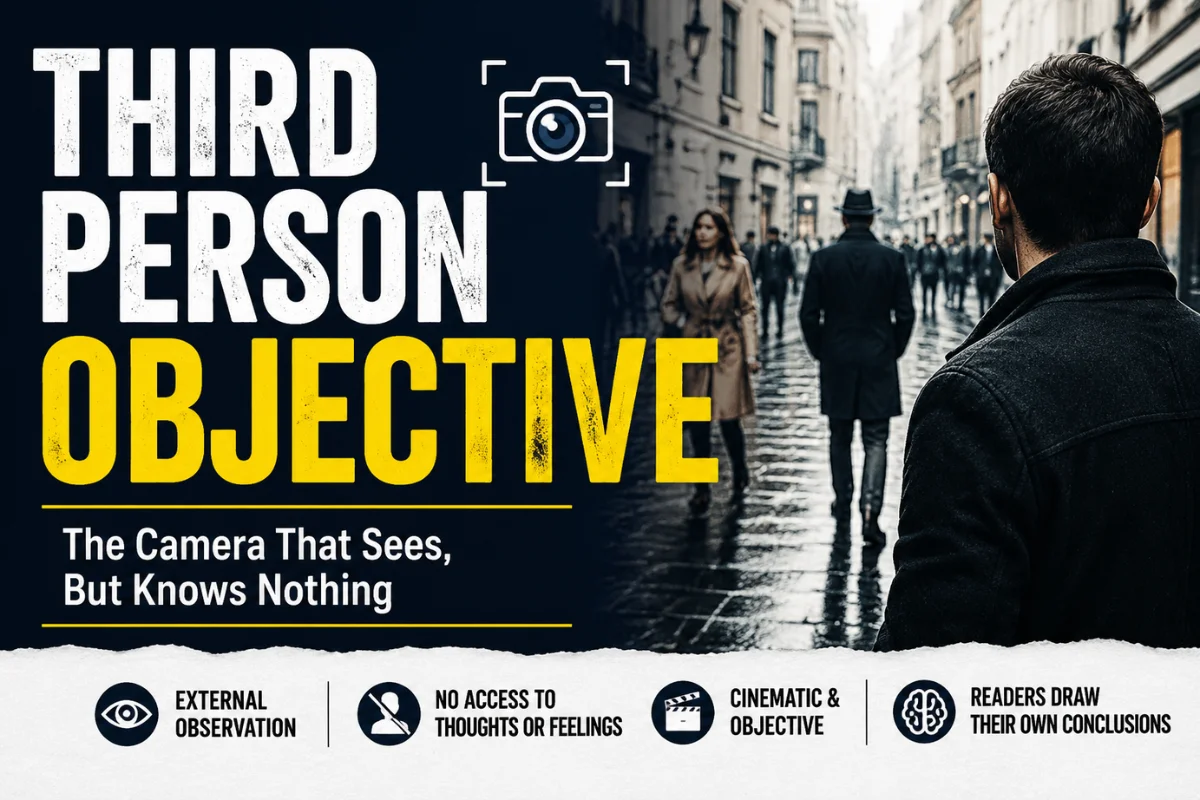
If you’ve spent any time studying narrative craft, you’ve probably run into the term third person objective and either nodded along or quietly wondered what sets it apart from the other third-person modes. I’ve been there. When I first started breaking down point of view in fiction, the objective mode seemed almost counterintuitive — a narrator who watches everything but knows nothing? That sounds limiting. But once I understood what it actually does on the page, I realized it’s one of the most powerful and demanding tools a writer can use.
This post covers everything you need to know about third person objective: what it is, how it works, when to use it, and how it compares to related narrative perspectives. Whether you’re a student of creative writing, a working novelist, or someone studying literature for academic purposes, understanding this point of view will sharpen how you read and write fiction.
What Is Third Person Objective?
Third person objective (sometimes called the dramatic or cinematic point of view) is a narrative mode in which the narrator reports only what can be observed from the outside — actions, dialogue, physical details — without access to any character’s internal thoughts, feelings, or motivations.
The narrator in this mode functions like a camera. It records. It doesn’t interpret. You see what characters do and hear what they say, but you’re never told what they’re thinking or why they made a choice. Every inference you draw as a reader must come from external evidence alone.
Here’s a stripped-down example to make this concrete:
Marcus set the letter on the table. He poured himself a glass of water, drank half of it, and went to stand by the window.
Notice what’s absent. You don’t know if Marcus is anxious, relieved, furious, or indifferent. You only know what he did. That restraint — that deliberate silence about inner life — is the defining feature of third person objective narration.
Third Person Objective vs. Other Points of View
To really understand this narrative mode, it helps to see it in direct comparison with the other major perspectives writers use. The differences aren’t subtle once you know what to look for.
The Third-Person Family
Third person narration divides into three main branches:
| Point of View | Access to Inner Life | Whose Mind | Narrator’s Relationship to Story |
|---|---|---|---|
| Third Person Omniscient | Full — can enter any character’s mind | All characters | God-like; knows everything |
| Third Person Limited | Full — but only for one character | One focal character | Close observer; knows one inner world |
| Third Person Objective | None — external observation only | No character | Detached reporter; knows nothing internal |
| First Person | Full — narrator’s own mind | The narrator/protagonist | Intimate; self-reported experience |
| Second Person | Varies | “You” as protagonist | Rare; used for specific effects |
The third person objective stance is the most restricted of all these. Unlike omniscient narration, it can’t dip into any character’s consciousness. Unlike limited narration, it doesn’t even have one mind to inhabit. The narrator stands entirely outside.
The Literary Origins of Third Person Objective
This approach didn’t emerge from nowhere. It has deep roots in American literary modernism, and one name comes up more than any other: Ernest Hemingway.
Hemingway’s “iceberg theory” — the idea that the dignity of a story’s movement comes from what’s left out — is essentially a philosophy of objective narration. His famous short story Hills Like White Elephants (1927) is a near-perfect example. Two characters talk at a train station. The reader never once enters their heads. Everything — the tension, the unspoken conflict, the emotional stakes — is delivered through dialogue and gesture alone.
Other writers associated with the objective mode include Dashiell Hammett, whose hardboiled detective fiction treats characters like case files rather than inner lives, and John Steinbeck in certain passages of Of Mice and Men. More recently, Cormac McCarthy’s dialogue-heavy prose operates in a similar spirit, though his narration sometimes edges toward limited.
Literary scholars like David Lodge, in The Art of Fiction (1992), identify the objective mode as particularly suited to conveying irony — the gap between what characters say and what they actually mean becomes the reader’s problem to solve, which creates a productive tension that other points of view often resolve too quickly.
Why Writers Choose Third Person Objective
At first glance, stripping out interiority seems like giving up your biggest tool. Internal monologue, the ability to render a character’s emotional state directly — these are powerful instruments. So why would a writer voluntarily set them aside?
It Creates Dramatic Irony at Scale
When the narrator refuses to tell you what a character feels, the reader is left to interpret behavior the same way we interpret real people’s behavior — through what we observe. This replicates something that’s fundamentally true about human experience: we never have direct access to another person’s inner life. Third person objective fiction makes that condition visible and makes the reader work for meaning.
It Forces the Writing to Earn Its Emotional Weight
Sentimentality creeps in when narrators tell readers how to feel. “She was heartbroken” is doing emotional labor that the prose should do instead. When you’re working in objective mode, you have to render the heartbreak through observable detail: the half-eaten meal she leaves on the counter, the way she keeps picking up her phone and setting it back down. That discipline produces stronger writing.
It Suits Certain Genres and Tones
Crime fiction, literary realism, and certain kinds of social satire are natural homes for the objective mode. When you want the reader to feel like a witness rather than a confidant — when moral judgment should emerge from observed behavior rather than authorial explanation — objective narration is the right tool.
Read Also: Burt Thicke: Patriarch Behind Alan & Robin Thicke
How to Write in Third Person Objective: The Practical Mechanics
If you’re planning to use this point of view in your own work, the rules are strict but learnable.
What You Can Include
- Physical actions and movements
- Dialogue (spoken words only, not internal reaction to them)
- Environmental details and setting
- Facial expressions and body language as visible events
- The sequence of events in time
What You Must Exclude
- Thoughts, even paraphrased (“He wondered if she was lying”)
- Emotional states stated directly (“She felt relieved”)
- Motivations explained by the narrator (“He said it to hurt her”)
- Sensory experience described as felt rather than observed (“The cold bit into his skin” crosses into interiority; “He pulled his coat tighter” stays outside)
That last distinction is subtle but important. Objective narration can describe a character’s behavior in response to cold, but it shouldn’t narrate the sensation of being cold as experienced from inside the character’s body.
The Role of Dialogue
Because dialogue is the one place where characters can express themselves directly, it carries enormous weight in objective fiction. Hemingway understood this. The unspoken subtext in a conversation — what characters won’t or can’t say — becomes the real story. Writers working in this mode need strong instincts for dialogue because it’s doing double duty: it’s both what’s said and the primary vehicle for what isn’t.
Common Mistakes Writers Make with Third Person Objective
Even writers who understand the theory slip up in practice. Here are the most frequent errors.
Accidental Interiority
This is the big one. A sentence like “James stared at the empty chair. He missed her” sneaks internal state in through the back door. The second sentence is telling us what James feels. In strict objective narration, it would need to become something observable: “James stared at the empty chair. He stood there for a long time before going back to the kitchen.”
Inconsistent Application
Some writers drift into objective narration unintentionally — not as a sustained choice but as a stylistic tic. This creates tonal inconsistency. If your story is predominantly third person limited and you occasionally forget to include interiority, readers feel the gap as a mistake rather than a deliberate effect. The objective mode works when it’s chosen consistently and purposefully.
Confusing Objective with Cold
Third person objective is not the same as emotionally flat. Some of the most emotionally devastating fiction uses this mode precisely because it trusts readers to feel what it refuses to name. The restraint isn’t indifference — it’s a formal decision about where meaning is made. Writers who conflate objectivity with coldness produce prose that feels inert rather than taut.
Third Person Objective in Academic and Nonfiction Contexts
The term “third person objective” also appears outside creative writing, particularly in academic writing and journalism. In these contexts, it refers to writing that avoids first-person perspective (“I”) and maintains neutrality rather than personal voice.
Academic style guides — including those from the American Psychological Association (APA) and the Modern Language Association (MLA) — have historically encouraged objective third-person writing to convey scholarly impartiality. The idea is that removing the author’s “I” creates distance between the writer and the argument, foregrounding evidence over personal authority.
This academic use of the term overlaps with but isn’t identical to the literary concept. In fiction, third person objective is about narrative access to character consciousness. In academic writing, it’s more about voice and the appearance of authorial neutrality. Understanding the distinction helps when you encounter the term across different disciplines.
Examples of Third Person Objective in Published Work
Seeing the technique in real texts is the best way to internalize it.
Hemingway’s Hills Like White Elephants remains the gold standard. The entire story unfolds in dialogue and sparse physical description. No reader is ever told what either character wants or fears; we have to read it in the rhythms of their conversation.
Raymond Carver’s early short stories — particularly those collected in What We Talk About When We Talk About Love (1981) — operate in a similarly stripped-down register. Carver was explicit about his debt to Hemingway, and his objective-adjacent narration creates the same productive ambiguity.
Shirley Jackson’s We Have Always Lived in the Castle occasionally employs objective-feeling passages to unsettle the reader’s trust in the narrator — a reminder that objective narration and unreliable narration can coexist in interesting ways.
If you want to study the technique systematically, I’d recommend pairing primary texts with John Gardner’s The Art of Fiction (1983) and Janet Burroway’s Writing Fiction: A Guide to Narrative Craft — two craft books that address point of view with genuine analytical rigor.
When Third Person Objective Is the Right Choice
Not every story benefits from this mode. Here’s a practical way to think about when it fits:
Use third person objective when you want readers to work for meaning, when your story’s power lies in behavioral observation rather than introspection, when you’re writing in a genre that rewards spare prose (crime, realism, certain kinds of psychological fiction), or when you want to preserve deliberate ambiguity about a character’s motives.
Avoid it when your story’s emotional core depends on interiority — when the gap between what a character knows and what they feel is itself the subject. Literary forms like psychological realism, autofiction, and stream-of-consciousness narration require access to inner life that the objective mode refuses.
The objective mode is a commitment. It works best when writers choose it fully, understand why they’re choosing it, and then hold the line consistently throughout the work.
You May Also Read: Nerwey: Emerging Digital Strategy & Brand Concept
Conclusion
Third person objective is one of the most disciplined narrative modes available to fiction writers, and one of the most misunderstood. It isn’t a limitation — it’s a formal choice with real aesthetic consequences, and when used with intention, it produces fiction that trusts readers to bring their own interpretive intelligence to the page.
If you’re serious about point of view as a craft element, I’d encourage you to try a short story written entirely in this mode. The constraint will teach you things about external behavior, dialogue, and observable detail that looser narrative approaches let you avoid confronting. That experience — writing without the safety net of interiority — will make you a more precise writer in whatever point of view you ultimately favor.
Read Hemingway closely. Read Carver closely. Then try it yourself.
Frequently Asked Questions
1. What is the main difference between third person objective and third person limited?
Third person limited allows the narrator to access one character’s internal thoughts and feelings, while third person objective restricts the narrator to external observation only — no character’s inner life is accessible.
2. Can a story use third person objective for some chapters and limited for others?
Technically yes, but shifting between modes requires careful signaling to avoid confusing readers. Most writers commit to one point of view throughout to maintain tonal consistency.
3. Is third person objective the same as omniscient narration?
No — they’re opposite ends of a spectrum. Omniscient narration can access any character’s mind; objective narration accesses none.
4. Why do some academic style guides recommend third person objective writing?
Academic writing uses third-person objective voice to project scholarly neutrality and focus attention on evidence rather than personal authority, which aligns with conventions of impersonal, evidence-based argumentation.
5. Is third person objective point of view harder to write than other perspectives?
Many writers find it more technically demanding because you can’t rely on telling readers what characters feel — every emotional effect must be earned through observable behavior, dialogue, and precisely chosen physical detail.
Sources and Further Reading:
- Hemingway, E. (1927). Hills Like White Elephants. Scribner’s Magazine.
- Lodge, D. (1992). The Art of Fiction. Penguin Books.
- Gardner, J. (1983). The Art of Fiction: Notes on Craft for Young Writers. Knopf.
- Burroway, J. (2019). Writing Fiction: A Guide to Narrative Craft (10th ed.). University of Chicago Press.
- Carver, R. (1981). What We Talk About When We Talk About Love. Knopf.
For More Reading: Milyom: Creative Blogging Platform Redefined

Marcus Vance is a digital journalist and trends analyst with over 7 years of experience covering technology, business, and lifestyle. At wellhealthorganic1.com, he delivers research-driven guides on emerging trends, productivity tools, and practical life hacks to help readers simplify routines and make informed decisions.