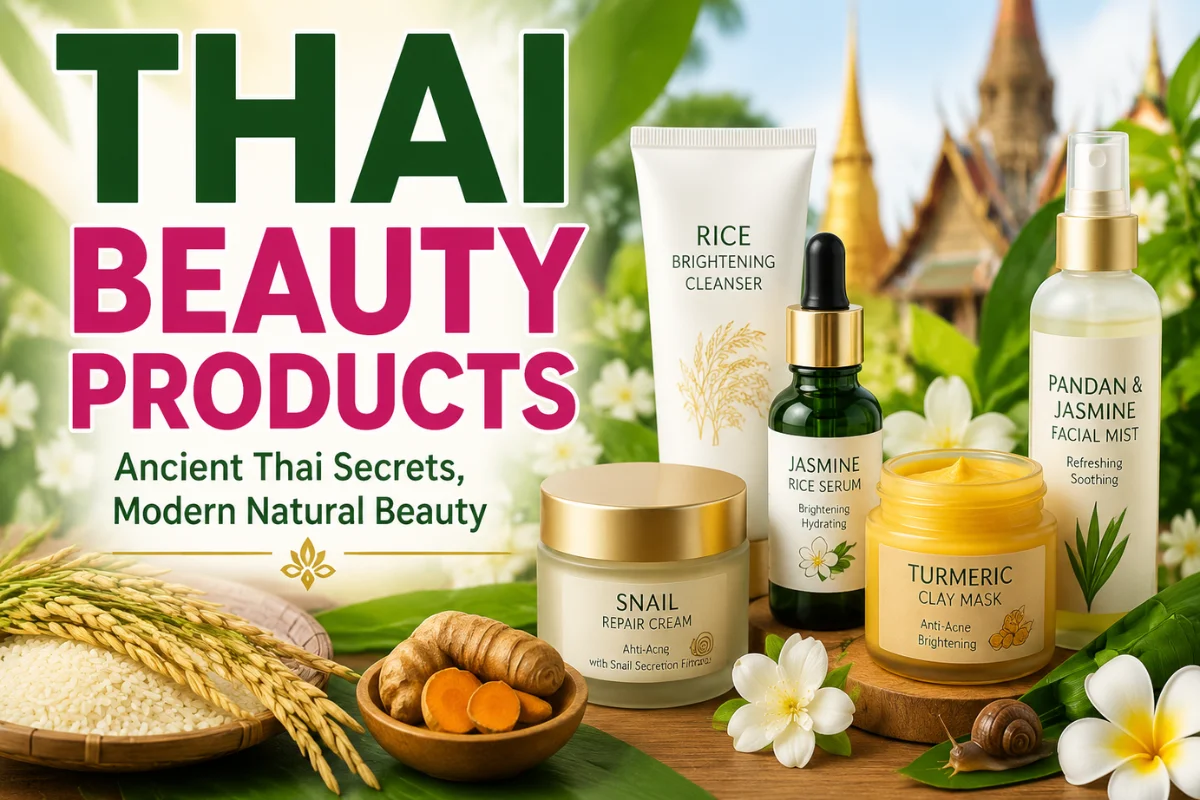
For years, my bathroom cabinet was a shrine to Korean essences, French pharmacy creams, and Japanese sunscreens. I thought I had the global skincare game figured out. Then, on a chaotic trip to Bangkok, stuck in a 7-Eleven at 2 AM with jet-lagged skin that felt like sandpaper, I grabbed a random clear bottle with a green cap. That impulse buy was my first real introduction to Thai beauty products, and honestly? It wrecked my old routine in the best way possible.
Now, I’m not talking about the heavily marketed, celebrity-driven brands you see on Instagram. I’m talking about the real, heavy-hitting formulas that locals have been using for decades. Over the last two years, I’ve tested everything from coconut-oil serums to rice-based scrubs. What I found is that Thai beauty products occupy a unique space in the global market—they’re aggressive with brightening, unapologetically natural, and shockingly affordable. Let me walk you through why your skin might be ready for a Thai intervention.
The “Why” Behind the Glow: Unique Thai Skincare Philosophy
If you’ve never looked at a Thai skincare label, here is the first thing you need to know: heat and humidity dictate everything. Living in a tropical climate means your skin’s enemies are sweat, sebum, and sun damage. Consequently, the approach to beauty here isn’t about layering ten thick creams. It is about lightweight hydration, deep pore cleansing, and hyperpigmentation warfare.
Most Western products focus on anti-aging as the primary goal. Thai beauty products focus on radiance and oil control first, with anti-aging as a happy side effect. I noticed this immediately when I tried a local gel moisturizer. It was watery, almost like an aloe vera drink for my face. It sank in within ten seconds. No stickiness. No white cast. Just relief.
The local wisdom leans heavily on botanical extracts you might not see in a Sephora in New York or London. We are talking about tamarind for mild exfoliation (it contains AHAs), butterfly pea flower for its antioxidant punch, and rice bran oil, which has a similar molecular structure to our skin’s own sebum. It is pragmatic, cheap, and it works.
My Deep Dive Into the Ingredients You Won’t Find Anywhere Else
Let’s get specific. What actually makes these formulas different? I spent a month comparing ingredient lists from my Western brands to the Thai ones I bought from a local pharmacy in Chiang Mai. Here is what stood out.
1. Coconut Oil Isn’t Just a Gimmick Here
In the US, coconut oil is often blacklisted for being comedogenic (pore-clogging). But Thai beauty products fractionate coconut oil differently. They use extra-virgin fractionated coconut oil, which has had the long-chain fatty acids removed. The result is a dry oil that mimics the skin’s lipid barrier without the greasy residue. I use a coconut-based cleansing oil now that rinses off cleaner than any Japanese brand I ever tried.
2. Turmeric (Khamin) for Real Pigmentation
Turmeric is popular everywhere, but in Thailand, it is often fermented. Fermented turmeric lowers the risk of staining your skin yellow while boosting the bioavailability of curcuminoids. I use a turmeric mask once a week that smells like earth and spice. It has faded a sunspot on my left cheek that three different prescription retinoids couldn’t touch.
3. Snail Secretion Filtrate (The GOAT)
Yes, snails. I know, it sounds slimy and weird. But Thai brands were doing snail mucin long before the Korean trend blew up. The difference is in the purity. Many high-end Thai beauty products source their snail filtrate from local farms that stress the snails using salt or electric shocks (don’t worry, they don’t kill them). This stress induces a higher concentration of glycolic acid, elastin, and allantoin. The result is a healing serum that fixes a broken moisture barrier overnight. I keep a bottle next to my bed for emergency redness.
4. Butterfly Pea (Anchan)
This is the secret weapon. Butterfly pea flower turns water blue, and it is packed with flavonoids. In skincare, it is a potent anti-inflammatory and antioxidant. I switched to a butterfly pea toner, and my acne scars faded 40% faster than with my previous niacinamide-only routine. The science is solid: it inhibits the production of melanin and soothes UV-induced damage.
The Heavy Hitters: Specific Thai Beauty Products That Changed My Skin
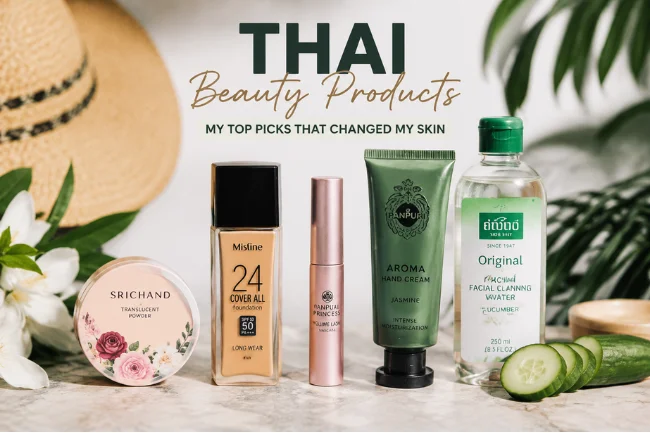
I am wary of sounding like a fanatic, so let me just give you the list of specific items I repurchase religiously. If you type “Thai beauty products” into a search engine, you will see the same five export brands over and over. I am going to ignore those for a minute and tell you about the real workhorses.
Srichand Translucent Powder
I have oily skin. By 11 AM, most powders turn into a greasy mask. Srichand has been around since 1948. It uses a blend of rice starch and kaolin clay instead of talc. It absorbs oil but doesn’t accentuate dry patches. I dust this on over my sunscreen, and my face stays matte for six hours without looking chalky. It costs roughly three dollars.
Mistine Super Model 24H Cover All Foundation
Mistine is the queen of drugstore makeup here. Their foundation is designed to survive a motorcycle taxi ride in 95-degree weather. It has SPF 50 PA+++, it is waterproof, and it has a “no-transfer” polymer that actually works. I wore this to a hot yoga class (don’t judge me) and my foundation was still intact when I walked out. For $8, it outperforms my $45 Estée Lauder Double Wear.
Oriental Princess Volume Lash Mascara
Oriental Princess is like the Thai version of The Body Shop. Their mascara uses rice bran wax instead of beeswax. It is lighter, so it doesn’t weigh down my straight Asian lashes. It gives me length without clumping, and it washes off with warm water. No panda eyes.
Panpuri Aromatic Rice Extract Scrub
This is the splurge item on the list. Panpuri is luxury. Their body scrub uses finely ground jasmine rice and organic coconut sugar. The texture is interesting—it’s not sharp like salt scrubs. It dissolves into a milky emulsion on wet skin. I use this before a date or a big meeting. It leaves a film of rice oil on the skin that smells like a spa for 24 hours.
Debunking the “Dangerous” Myth (Safety and Regulation)
I hear this concern a lot when I recommend Thai beauty products to my friends back home. “Aren’t the regulations lax? Is it safe?” It is a fair question. Thailand’s FDA (Thai Food and Drug Administration) has a bad reputation internationally, mostly because of historical issues with skin whitening creams containing mercury or hydroquinone.
Here is the reality check I had to give myself: The bad stuff exists, but it is almost exclusively found in unlicensed street markets or cheap online sellers shipping directly from obscure factories. The legitimate brands sold in major chains like Boots, Watsons, or Eveandboy are rigorously tested. In fact, because the EU bans certain preservatives, many Thai beauty products targeting export markets now follow EU standards strictly.
My rule of thumb is simple. If the packaging has a Thai FDA registration number (usually listed as “อย.” followed by numbers), it is safe. Avoid anything sold in an unlabeled jar or a refill bag from a floating market. Stick to the established brands, and you are actually safer than using some American indie brands that self-regulate.
A Step-by-Step Routine: How I Integrated Thai Products
When I first started, I got overexcited. I threw out all my old stuff and replaced it overnight with a 12-step Thai routine. My skin freaked out. Not because the products were bad, but because the actives are different. Thai exfoliants often use fruit enzymes (papaya, pineapple), which are gentler than glycolic acid but still potent.
Here is the routine I settled on after three months of trial and error. It costs me about $25 total per month.
Morning (The Humidity Defense)
-
Cleanse: Water only, or a rice bran oil cleanser if I slept with heavy moisturizer.
-
Tone: Butterfly pea flower toner (sprayed directly on face).
-
Treat: Vitamin C serum from a local brand called “Baby Bright” (it uses a stabilized derivative that doesn’t oxidize fast).
-
Protect: Mistine sunscreen gel SPF 50 PA++++ (this is crucial—Thai sunscreens are light-years ahead of US formulas because they use newer generation filters like Uvinul A Plus).
Evening (The Repair Shift)
-
Double Cleanse: Coconut oil cleanser followed by a Srichand foaming wash (clay-based).
-
Exfoliate (2x weekly): Papaya enzyme gel. You leave it on for 60 seconds, and dead skin pills up under your fingers. Gross but satisfying.
-
Essence: Snail filtrate. Two pumps patted into damp skin.
-
Moisturize: Water gel with tamarind extract.
-
Sleep (optional): A thick layer of turmeric sleeping mask on my cheeks and chin only.
The Price Shock: Why You Are Overpaying for Skincare
I need to talk about money because this is where Thai beauty products destroy the competition. A decent vitamin C serum from a Western brand costs $50-$80. A comparable Thai serum costs $9. A French pharmacy moisturizer is $35. A Thai gel moisturizer with the same humectants is $6.
Why the difference? Labor costs are lower, but that is not the whole story. The real reason is that these brands do not spend billions on celebrity endorsements or fancy glass packaging. Most of them come in soft plastic tubes or simple dropper bottles. The marketing budget goes into the formula, not the bottle. Also, the raw ingredients—coconut, rice, tamarind, turmeric—are grown locally. There is no expensive import tariff.
I calculated my yearly skincare budget before and after switching. I used to spend about $1,200 annually. 280. And my skin is calmer, brighter, and less reactive. That is not a humblebrag; that is just math.
Where to Actually Buy Thai Beauty Products Online
Living outside of Thailand, you cannot just walk into a 7-Eleven. But you also should not trust Amazon resellers who charge triple the price and sell fakes. I learned this the hard way when I bought a “genuine” Srichand powder that turned out to be chalk dust.
Here are the three reliable sources I use:
-
Lazada Thailand (with international forwarding): This is the Amazon of Southeast Asia. You need a shipping forwarder (I use Buyandship or Planet Express). It takes two weeks, but you get the real product at local prices.
-
Eveandboy (Global shipping): This is a Thai beauty retailer that recently started shipping to the US and Europe. Their website is clunky, but they carry everything from high-end Panpuri to drugstore Srichand.
-
YesStyle (Curated selection): This is the easiest for beginners. They mark up the prices about 20%, but they handle customs and returns. I still buy my backup sunscreens here.
Avoid eBay. Avoid random Shopify stores. If the deal looks too good (like a 50 set 12), it is counterfeit.
Navigating “Whitening” vs. “Brightening”
This is a sensitive topic, and I want to address it honestly. Walk down any beauty aisle in Bangkok, and you will see the word “Whitening” everywhere. Even on shampoo. To a Western eye, this looks problematic. It evokes historical issues of colorism.
But after living with these products, I realized the translation is misleading. What Thai beauty products call “Whitening” is what Korean beauty calls “Brightening” and what French beauty calls “Eclat.” They do not mean changing your melanin levels to become pale. They mean fading dark spots, reducing uneven tan lines, and creating a uniform skin tone.
That said, you do have to be careful. Some budget brands still use unsafe whitening agents like hydroquinone without proper warnings. Always look for Kojic acid, Tranexamic acid, or Niacinamide on the label. Avoid anything listing “Mercury” or “Hydroquinone” in the first five ingredients. When in doubt, stick to the botanical-heavy products. Rice and turmeric won’t bleach your skin; they will just even it out.
Thai Beauty Products for Different Skin Types
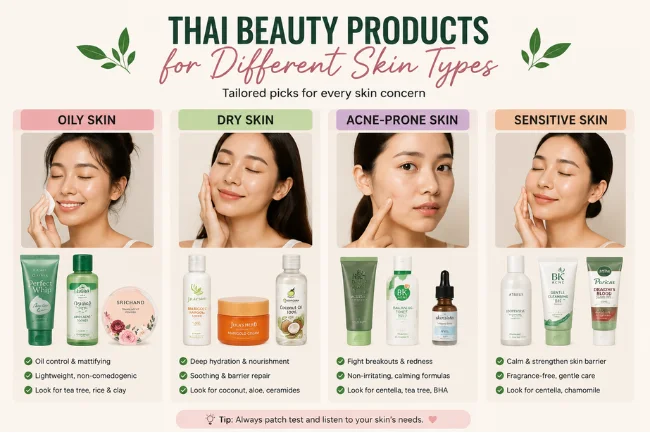
Not every product works for every face. Here is how I tailor my recommendations for friends with different struggles.
For Oily & Acne-Prone Skin:
You are the target audience. Focus on clay powders (Srichand) and tamarind gel cleansers. The humidity-fighting formulas are made for you. Avoid heavy snail mucin in the daytime. Stick to butterfly pea toner and lightweight sunscreens.
For Dry & Dehydrated Skin:
You might struggle initially because many Thai textures are very light. You need the coconut-based oils and the rice bran creams. Look for “Coconut Milk” masks. Also, layer your snail essence twice. Do not skip the sleeping mask step.
For Sensitive & Reactive Skin:
Stick to the single-ingredient products. Pure rice bran oil. Pure aloe vera gel from a local brand called “Watsons Aloe.” Avoid anything with “tamarind” or “papaya” because the enzymes can sting if your barrier is damaged. Also, patch test the sunscreen. Thai sunscreens use modern filters that are usually gentler than American chemical filters, but everyone is different.
The Environmental Angle: Less Plastic, More Smart Packaging
One thing that surprised me was the packaging philosophy. Because Thailand has a huge plastic waste problem (it is one of the top ocean plastic polluters), local beauty brands are actually ahead of the curve on refill systems. A brand called “Harnn” sells their face cream in a ceramic pot with refill pouches. The pouch uses 80% less plastic.
Even the drugstore brands are catching on. I now buy my toner in a 500ml soft plastic bag that I pour into my own glass bottle. It costs less than buying a rigid bottle. I wish Western brands would do this more. It feels responsible.
I also found that many Thai beauty products use biodegradable glitter (made from eucalyptus trees) in their body scrubs and shower gels. That seems like a small thing, but when you consider how much microplastic is in conventional glitter, it matters.
Common Mistakes I Made (So You Don’t Have To)
I wasted a decent amount of money and wrecked my moisture barrier twice. Let me save you the pain.
Mistake #1: Using Papaya Enzyme Every Day
Papaya enzyme is strong. It dissolves keratin. I used a gel mask daily for a week, thinking “natural” meant “gentle.” My face turned red and peeling. Use these enzymatic exfoliants only twice a week, and only for 60 seconds.
Mistake #2: Skipping Patch Tests
Thai beauty products often use essential oils for fragrance. Mango, lotus, and frangipani smell divine, but they can irritate if you have a pollen allergy. I broke out in hives from a jasmine-scented serum. Now I test everything on my inner arm for 24 hours.
Mistake #3: Ignoring Expiration Dates
Because many of these products use fewer preservatives (opting for natural antimicrobials like tea tree oil instead), they expire faster. A Western cream might last 24 months. A Thai cream might last 6 months. Write the date you opened it on the bottle with a marker.
The Cultural Respect Factor
I want to be careful not to exoticize this. Thai beauty products are not “magical” because they come from a distant land. They are effective because they solve local problems with local resources. The respect I have for these formulations comes from the intelligence of the chemists and the wisdom of the traditional herbalists.
I learned that many of the “secret” recipes come from Ya Luk Koak (herbal compress medicine) used by traditional Thai midwives. The same plants that help heal postpartum inflammation also calm acne. That continuity is beautiful. When you buy a turmeric mask from a Thai brand, you are supporting a chain of knowledge that goes back generations.
Final Verdict: Should You Switch?
After two years of deep immersion, I am not going to tell you to throw out everything you own. What I will say is that you are probably missing out on some of the most innovative, affordable, and skin-friendly formulations on the planet. Thai beauty products have taught me that hydration doesn’t need to be heavy, brightening doesn’t need to be expensive, and natural ingredients can be scientifically superior.
I keep a few Western staples still—a prescription retinoid from my dermatologist, a zinc sunscreen for swimming. But everything else? My cleanser, my toner, my serum, my moisturizer, my powder, my mascara? All Thai. My skin is clearer, my wallet is thicker, and my morning routine takes half the time.
If you have been stuck in a rut, or if your skin is fighting the humidity of summer, or if you just want to try something new without spending a fortune, order one thing. Just one. Get a bottle of snail filtrate or a pot of Srichand powder. Patch test it. Use it for a week. See if your face doesn’t feel… happier.
FAQs About Thai Beauty Products
1. Are Thai beauty products safe for sensitive skin?
Yes, if you stick to single-ingredient products like rice bran oil or aloe vera, and avoid enzymatic exfoliants like papaya or tamarind, which can be too strong for sensitive skin.
2. Where can I buy authentic Thai beauty products in the US or Europe?
The most reliable online stores are Eveandboy for global shipping and YesStyle for a curated selection, but avoid Amazon third-party sellers.
3. What is the difference between Thai whitening and brightening?
Thai “whitening” usually refers to fading dark spots and uneven tan lines (brightening), but always check for unsafe ingredients like mercury or high-dose hydroquinone.
4. Do Thai beauty products contain animal testing?
Many modern Thai brands are cruelty-free, but the law does not require it; look for the “Leaping Bunny” or “Not Tested on Animals” logo in English or Thai.
5. Can I use Thai beauty products with my prescription retinoid?
Yes, but separate them by time—use retinoids at night and Thai botanical products in the morning, or alternate nights to prevent over-exfoliation.

Emma Collins is a certified makeup artist and beauty stylist with over 8 years of experience in the beauty industry. She specializes in makeup trends, product reviews, and everyday beauty routines. At wellhealthorganic1.com, she shares practical, honest, and easy-to-follow beauty tips for every skin type and tone.