
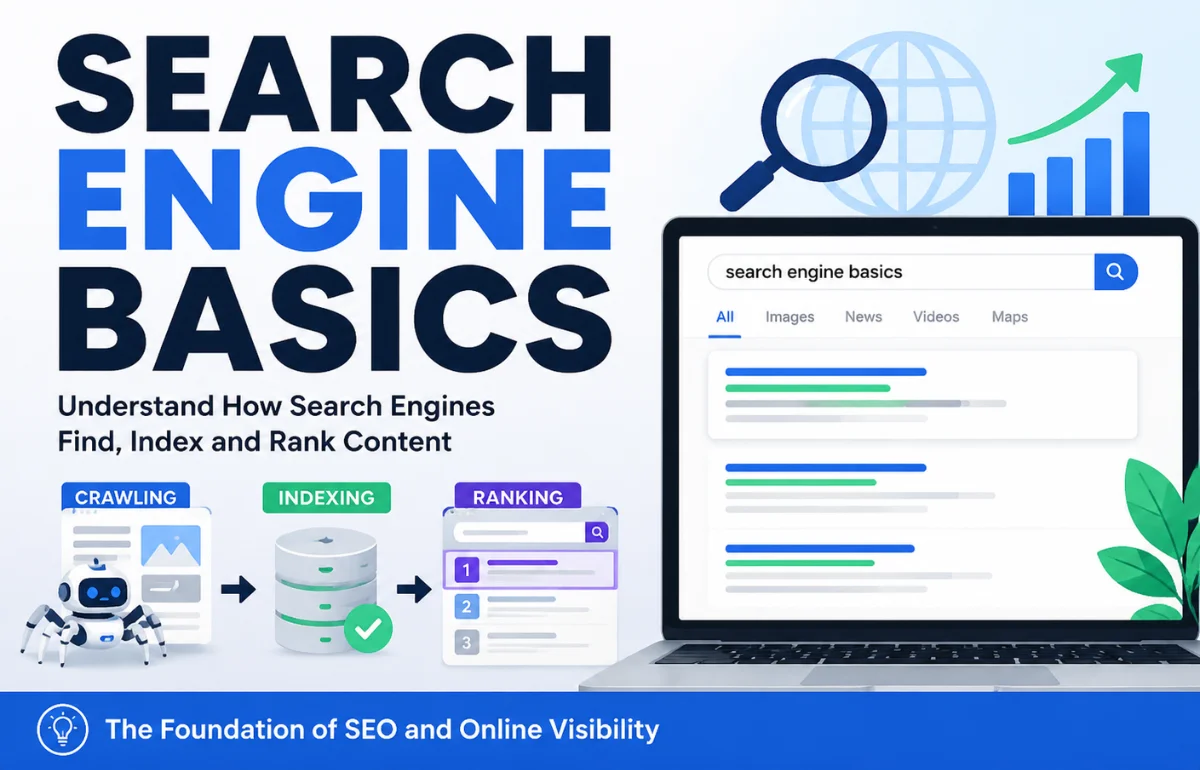
Search engine basics means understanding how search engines find, organize, and rank web pages so people can get useful answers when they type or speak a query. In simple words, a search engine works like a massive digital librarian. It discovers pages through crawling, stores useful pages through indexing, and chooses the best results through ranking.
When I explain search engine basics to beginners, I usually say this: Google does not search the live internet every time you type something. It searches its own huge index of discovered pages and then sorts the most relevant results for your query. That small difference clears up a lot of confusion.
If you own a website, write content, run a business, or simply want to understand how online visibility works, these basics are not optional. They are the foundation of SEO, content strategy, and modern AI search visibility.
What Is a Search Engine?
A search engine is a system that helps users find information from the web. Google, Bing, Yahoo, DuckDuckGo, and other platforms collect web pages, understand their content, and display results that match a user’s search intent.
Google explains that its search engine uses automated software called web crawlers to regularly explore the web and find pages to add to its index. Most pages are not manually submitted; they are discovered automatically when crawlers follow links across the internet.
That is why search engines feel instant. Behind the scenes, they have already done much of the heavy work before you search.
Why Search Engine Basics Matter
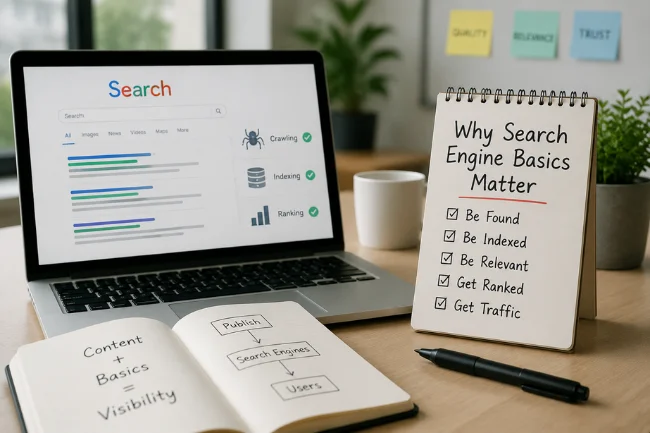
Search engines decide which pages people see first. That makes them powerful for education, business, publishing, e-commerce, local services, and personal brands.
- If your page is not crawlable, search engines may not find it.
- If your page is not indexable, it may not appear in search results.
- If your page is not useful, relevant, or trustworthy, it may not rank well.
I have seen websites publish dozens of articles and still get almost no organic traffic because they skipped the basics. Their content existed, but search engines could not properly understand it. Sometimes the problem was poor internal linking. Sometimes it was thin content. Sometimes the page was accidentally blocked from indexing.
The uncomfortable truth is this: publishing content is not the same as making content searchable.
The Three Main Stages: Crawling, Indexing, and Ranking
Every beginner should understand these three stages first. They are the backbone of search engine basics.
Crawling
Crawling is the discovery process. Search engines send bots, often called crawlers or spiders, to visit web pages. These bots follow links from one page to another and collect information about what they find.
For example, if your homepage links to your blog, and your blog links to a new article, a crawler can follow that path and discover the article.
Pages with strong internal links are easier to discover. Orphan pages, which have no internal links pointing to them, are harder for search engines to find.
Indexing
Indexing means storing and organizing a page in the search engine’s database.
A page can be crawled but not indexed. This usually happens when the page is low-quality, duplicated, blocked by a noindex tag, has technical problems, or does not look useful enough for search results.
Google also makes clear that following technical requirements does not guarantee crawling, indexing, or serving in search results. That matters because many website owners assume “published” means “indexed.” It does not.
Ranking
Ranking is the process of sorting indexed pages based on relevance, quality, usefulness, authority, freshness, location, page experience, and search intent.
If someone searches “best running shoes for flat feet,” the search engine does not simply show pages that repeat those words the most. It tries to understand what the user wants: product recommendations, comparisons, expert advice, comfort factors, and buying guidance.
Modern ranking is not about keyword stuffing. It is about satisfying the reason behind the search.
Crawling vs Indexing vs Ranking
| Stage | What It Means | Simple Example | Common Problem |
|---|---|---|---|
| Crawling | Search engine discovers the page | Googlebot finds your new blog post through a link | Page has no internal links |
| Indexing | Search engine stores the page | Google adds your article to its searchable database | Page has noindex tag or thin content |
| Ranking | Search engine sorts the page in results | Your article appears on page one or page five | Better competitors answer the query more fully |
This table is simple, but it solves a common beginner mistake. People often say, “Google is not ranking my page,” when the real issue is that Google has not indexed it yet.
What Is a Search Index?
A search index is a giant organized database of web pages and information. Search engines use the index to retrieve results quickly.
Think of it like the index at the back of a textbook, but millions of times more advanced. Instead of flipping through every page manually, the search engine already knows which pages discuss certain topics, entities, questions, locations, products, and phrases.
The index does not just store words. It also tries to understand relationships.
For example, a page about “search engine basics” may also be connected to SEO, crawling, indexing, ranking, search intent, SERPs, algorithms, backlinks, mobile-first indexing, and AI search.
That semantic understanding is why your article should cover the topic naturally instead of repeating one exact keyword again and again.
What Is a Search Algorithm?
A search algorithm is the set of systems and rules that search engines use to decide which results appear for a query.
Nobody outside Google knows the full algorithm. That is intentional. But Google has clearly stated many broad principles: make content helpful, reliable, people-first, crawlable, accessible, and easy to understand. Google’s SEO Starter Guide says SEO is about improving a site’s presence in Search and helping search engines crawl, index, and understand content.
The algorithm looks at many signals, including:
- Content relevance
- Search intent
- Page quality
- Website trust
- Internal links
- External links
- Freshness
- Mobile usability
- Page experience
- Structured data
- Location, when relevant
- User query context
The exact mix changes depending on the query. A local search, medical search, product search, and news search do not need the same kind of results.
What Is Search Intent?
Search intent is the real goal behind a search query.
This is one of the most ignored parts of search engine basics, but it is also one of the most important.
When someone searches “search engine basics,” they are probably not ready for advanced technical SEO. They want a clear explanation of what search engines are, how they work, and why it matters.
Search intent usually falls into four main categories.
| Search Intent | What the User Wants | Example Query | Best Content Type |
|---|---|---|---|
| Informational | Learn something | what is crawling in SEO | Guide, explanation, FAQ |
| Navigational | Find a specific site or brand | Google Search Console | Homepage, tool page |
| Commercial | Compare options before deciding | best SEO tools for beginners | Comparison article |
| Transactional | Take action or buy | hire SEO consultant | Service page, landing page |
The best-ranking content usually matches intent better than competitors. It does not just contain the right words. It gives the right answer in the right format.
What Appears on a Search Results Page?
A search results page is often called a SERP. It is the page you see after entering a query.
A modern SERP can include much more than ten blue links. Depending on the query, you may see:
- Organic results
- Paid ads
- Featured snippets
- AI Overviews or AI Mode results
- People Also Ask boxes
- Images
- Videos
- Local map packs
- Shopping results
- Knowledge panels
- News results
- Site links
This matters because ranking number one is not the only goal anymore. Sometimes the most visible result is a featured snippet, a local pack, a video, or an AI-generated answer that cites sources.
Google’s 2026 AI Search updates show how search is moving beyond simple links toward answers, follow-up questions, AI Overviews, AI Mode, and agent-like search experiences.
For content creators, that means your article should be clear enough for humans and structured enough for machines to understand.
How Search Engines Understand Content
Search engines look at more than the visible words on a page.
They examine titles, headings, body content, images, links, schema markup, page layout, loading performance, mobile usability, and how the page connects with the rest of the website.
Here are the basic elements search engines use to understand your content:
Title Tag
The title tag tells search engines and users what the page is about. A good title is specific, natural, and aligned with the query.
Meta Description
The meta description does not directly guarantee rankings, but it can influence clicks. It should summarize the page clearly and give users a reason to open it.
Headings
Headings organize your page. They help readers scan and help search engines understand your structure.
Your H1 should describe the main topic. H2s should divide major sections. H3s should support those sections.
Internal Links
Internal links help search engines discover pages and understand relationships between topics.
A strong article about search engine basics could internally link to articles about SEO, keyword research, Google Search Console, technical SEO, and content optimization.
External Links
External links to trusted sources can support factual claims. They also help readers verify important information.
Images and Alt Text
Images can make content easier to understand. Alt text helps describe images for accessibility and search engines.
Search Engine Basics for AI Search
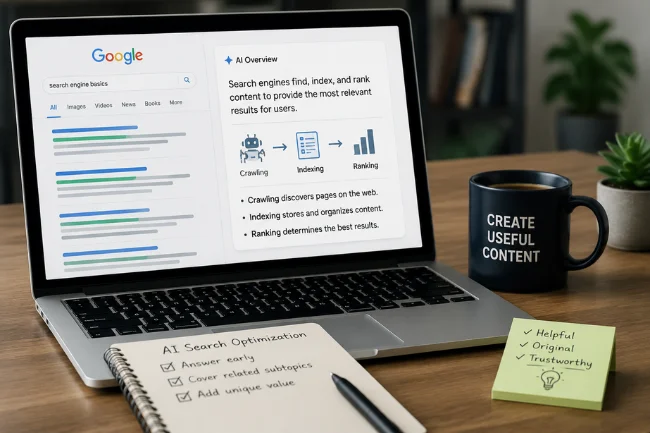
This is where many old articles are weak. Search is no longer only about ranking in traditional results. AI search experiences summarize, compare, and answer questions directly.
That does not mean SEO is dead. It means shallow SEO is dying.
If your content is vague, copied, thin, or written only to hit keywords, AI systems have little reason to use it. But if your content gives original explanations, real examples, expert insight, clean structure, and direct answers, it has a better chance of being useful across traditional search and AI-assisted search.
In my experience, the content that performs best in modern search usually has three qualities:
- It answers the main question early.
- It explains related subtopics without wandering.
- It adds something competitors did not say.
For this topic, the missing information is often practical. Many articles explain crawling and indexing, but they do not explain what a website owner should actually check.
Practical Search Engine Checklist for Beginners
If you are learning search engine basics because you own a site, start with these checks.
- Make sure your important pages are linked from other pages.
- Check that your pages are not blocked by robots.txt.
- Avoid using a noindex tag on pages you want in Google.
- Submit an XML sitemap in Google Search Console.
- Use clear title tags and headings.
- Write content that fully answers the user’s query.
- Add original examples, visuals, or experience.
- Make the page mobile-friendly.
- Improve page speed where possible.
- Use HTTPS for security.
- Avoid duplicate pages targeting the same keyword.
- Update outdated information.
Google says page experience can impact how a site ranks in Search, and it recommends evaluating signals such as Core Web Vitals, HTTPS, mobile experience, and usability.
Do not obsess over every technical detail on day one. First, make sure your page can be found, understood, indexed, and trusted.
Common Beginner Mistakes
The first mistake is thinking keywords alone are enough. They are not. Keywords help define the topic, but usefulness wins the page.
The second mistake is writing for search engines before writing for people. That usually creates stiff content nobody wants to read.
The third mistake is ignoring internal links. I have seen good pages stay invisible because they were buried deep on a website with no clear path for crawlers or users.
The fourth mistake is copying competitor headings without adding anything new. If your article is just a rearranged version of what already ranks, it gives Google and readers no strong reason to prefer it.
The fifth mistake is publishing and never updating. Search behavior changes. SERP features change. AI search changes. Your content should not sit untouched for years.
What Makes a Page Rank Better?
There is no single ranking trick. Better rankings usually come from a combination of relevance, quality, technical accessibility, trust, and user satisfaction.
A strong page usually does these things well:
- It answers the query directly.
- It covers the topic completely without padding.
- It uses clear headings.
- It explains terms in plain language.
- It includes examples and comparisons.
- It loads well on mobile.
- It links to useful related pages.
- It shows real expertise or experience.
- It avoids exaggerated claims.
- It stays updated.
For search engine basics, that means your article should not only define crawling, indexing, and ranking. It should also explain SERPs, intent, AI search, practical checks, and beginner mistakes.
That is how you move from basic content to genuinely helpful content.
How Search Engines Are Changing in 2026
Search is becoming more conversational. People no longer search only short phrases like “SEO basics.” They ask full questions, compare options, and expect direct answers.
AI Overviews and AI Mode are part of this shift. Google’s guidance for AI features says site owners should focus on content that is useful, accurate, and eligible to appear in regular Search with snippets.
The best response is not to chase every new trend. The best response is to strengthen the fundamentals.
- Make your content easy to crawl.
- Make it easy to index.
- Make it easy to understand.
- Make it worth citing.
- Make it better than generic summaries.
Search engines are changing, but the core idea remains the same: help users find the most useful answer.
Final Thoughts
Search engine basics are the foundation of online visibility. Once you understand crawling, indexing, ranking, search intent, SERPs, and content quality, SEO becomes much less mysterious.
The next smart move is simple: pick one important page on your website and audit it using the basics from this article. Check whether it is crawlable, indexable, useful, well-structured, internally linked, and clearly written for the person behind the search.
That one page will teach you more than reading ten vague SEO tips.
Frequently Asked Questions
What are search engine basics?
Search engine basics are the core ideas behind how search engines discover, store, and rank web pages to answer user queries.
What are the three main functions of a search engine?
The three main functions are crawling, indexing, and ranking. Crawling discovers pages, indexing stores them, and ranking orders them in search results.
What is the difference between crawling and indexing?
Crawling means a search engine finds a page. Indexing means the search engine stores that page so it can appear in search results.
Why is search intent important in SEO?
Search intent matters because Google tries to show results that match what the user actually wants, not just pages that repeat the keyword.
Are keywords still important for search engines?
Yes, keywords still help define the topic, but modern search also looks at meaning, usefulness, quality, trust, and how well the content satisfies the query.

Marcus Vance is a digital journalist and trends analyst with over 7 years of experience covering technology, business, and lifestyle. At wellhealthorganic1.com, he delivers research-driven guides on emerging trends, productivity tools, and practical life hacks to help readers simplify routines and make informed decisions.