
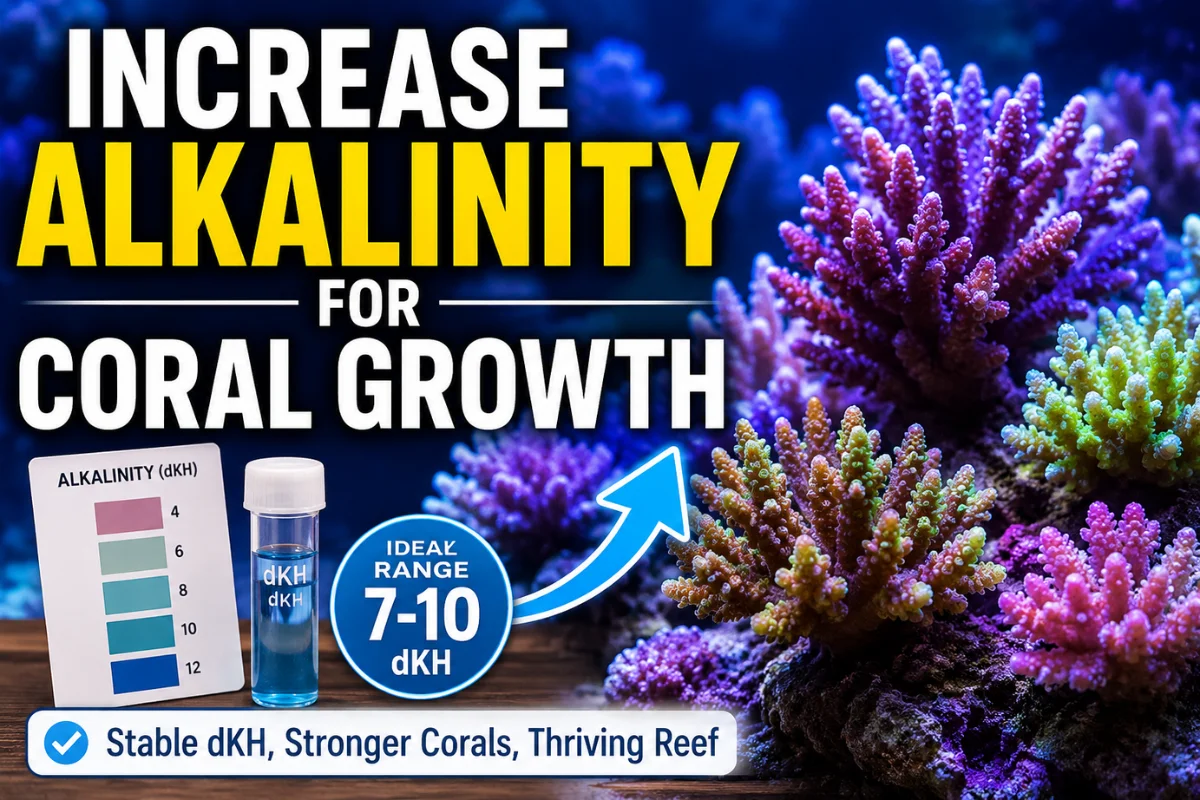
I remember the exact moment my reef tank stopped feeling like a science experiment and started feeling like a thriving piece of the ocean. I had beautiful lighting, strong flow, and my fish were happy. But my corals? They looked bored. Pale tips, sluggish extension, and growth that you could measure in millimeters per month if you squinted hard enough. After weeks of frustration, I finally tested my alkalinity. It was sitting at 5.8 dKH. That’s when I realized I had no idea how to properly increase alkalinity for coral growth without causing chaos in the tank.
Turns out, I wasn’t alone. Most hobbyists either ignore alkalinity until something looks wrong or they chase it like a stock market trend—dosing heavily one day, panicking the next. Over the last few years of running my own mixed reef system and talking with veteran aquarists, I’ve landed on a simple truth: stable alkalinity matters more than a perfect number, but you do need to know how to raise it safely. In this post,
I’ll walk you through exactly what worked for me, what failed miserably, and how you can increase alkalinity for coral growth without burning your acropora or turning your tank into a chemistry set.
Jump to:
ToggleWhy Alkalinity Is the Unsung Hero of Coral Skeletons
Before we talk about solutions, let’s get one thing straight. Alkalinity isn’t some abstract water parameter you adjust because a forum post said so. It’s the measure of your water’s ability to buffer against pH drops, but more importantly for us reefers, it represents the availability of carbonate ions (CO3²⁻). Corals—especially stony corals like Acropora, Montipora, and Euphyllia—use those carbonate ions to build their calcium carbonate skeletons.
Think of alkalinity as the bricks and calcium as the mortar. You can pour all the calcium you want into the tank, but without enough alkalinity, those bricks won’t stack. When I finally committed to learning how to increase alkalinity for coral growth in a controlled way, I saw new axial corallites within two weeks. That’s not an exaggeration. My purple stylo went from a nub to a small colony in under three months.
But here’s where most people get tripped up. Alkalinity isn’t static. It gets consumed daily, sometimes hourly, depending on your coral density, lighting intensity, and even your refugium light cycle. If you’re not testing and supplementing with intention, you’re essentially leaving growth on the table.
My First Mistake: Thinking “More Is Better” When Trying to Increase Alkalinity for Coral Growth
Let me save you the headache I went through. Early on, I read that natural seawater alkalinity hovers around 7-8 dKH and that many successful SPS tanks run between 8 and 12 dKH. So what did I do? I dumped in a commercial alkalinity booster one evening to take my tank from 6.5 to 10 dKH in about four hours.
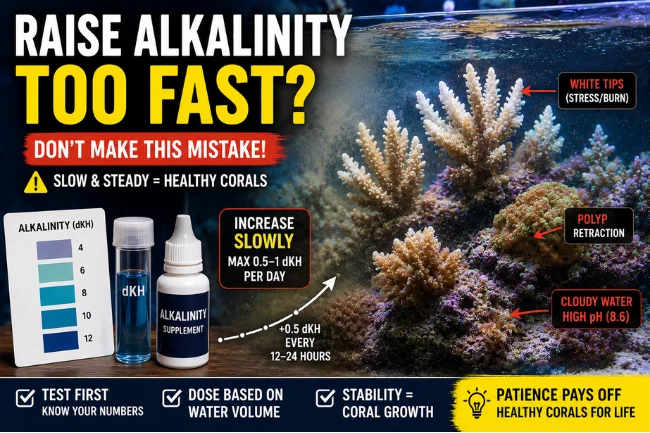
The next morning, I saw white tips on my acros. Not the good kind of growth tips—the kind that says “you just burned me.” Several LPS corals retracted their polyps, and my pH spiked to 8.6. That’s when I learned that increasing alkalinity isn’t a sprint. It’s a slow, measured climb.
The safe rate that experienced reefers taught me is no more than 1 dKH per day. Ideally, you want to raise it by 0.5 dKH every 12 to 24 hours. Anything faster than that, and you risk shocking the coral’s zooxanthellae, causing tissue necrosis, or precipitating calcium out of solution (which makes your water cloudy and your heater crusty).
So when you plan to increase alkalinity for coral growth, always test first, then calculate your dose based on your total water volume, not tank size. A 100-gallon tank with 80 pounds of rock and sand might only hold 70 gallons of actual water. That difference matters when you’re measuring milliliters of supplement.
Three Proven Ways to Safely Increase Alkalinity for Coral Growth
Over time, I’ve settled into three primary methods to raise alkalinity, depending on the tank’s needs, my schedule, and how lazy I’m feeling that week. Each has pros and cons, but all of them work when done correctly.
Two-Part Dosing: The Safest Way to Increase Alkalinity for Coral Growth as a Beginner
This is where I started, and honestly, it’s where most reefers should begin. Two-part solutions separate alkalinity (usually sodium carbonate or sodium bicarbonate) from calcium (calcium chloride). By dosing them separately, you avoid precipitation and maintain ionic balance.
When I wanted to increase alkalinity for coral growth without touching my calcium levels, I’d use only the alkalinity part of the two-part system. The trick is to drip it slowly into a high-flow area, preferably near a powerhead or return pump outlet. Never dump it directly onto a coral. I learned that one the hard way when a glob of alkalinity solution landed on a favia and bleached a nickel-sized spot for two weeks.
My routine looked like this:
-
Test alkalinity at the same time every day (I chose 8 PM, right before my nighttime viewing).
-
Calculate the dose needed to raise dKH by 0.5.
-
Split that dose into two smaller doses 12 hours apart if using a manual method.
-
Or use a cheap Jebao doser to automate it.
Within a month, my alkalinity went from erratic swings between 6.2 and 8.0 to a rock-solid 7.8 to 8.1 daily range. Growth exploded.
Using Kalkwasser to Increase Alkalinity for Coral Growth and Boost pH
Kalkwasser is old-school, but don’t let that fool you. It’s brilliant for tanks with moderate demand. Calcium hydroxide dissolved in top-off water not only raises alkalinity and calcium in perfect balance but also boosts pH by consuming CO2. For my soft coral and LPS tank, kalkwasser alone was enough to increase alkalinity for coral growth gradually.
The downside? You can’t raise alkalinity independently with kalkwasser. It always adds calcium at a fixed ratio. If your calcium is already high (say, above 480 ppm), adding kalkwasser will push it too far. Also, the solution must be clear. If you dump undissolved slurry into your tank, you risk burning coral tissue.
I ran kalkwasser through a simple gravity-fed ATO reservoir for two years. My alkalinity held steady at 8.3 dKH, and my monti caps grew so fast they started shading out lower corals. That’s a good problem to have.
The Balling Method: How Heavy SPS Tanks Increase Alkalinity for Coral Growth Hour by Hour
Once my tank became dominated by acropora, the consumption got wild. I was losing 1.5 to 2 dKH per day. Two-part dosing became tedious, and kalkwasser couldn’t keep up without raising my pH too high during the day.
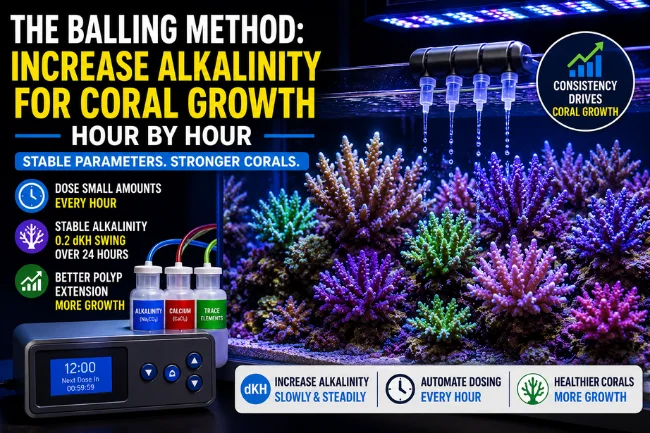
That’s when I moved to the Balling method. It’s a refined version of the two-part that includes a third component—trace elements—to maintain ionic balance. By using a dosing pump to add small amounts every hour, I could increase alkalinity for coral growth on a micro-scale, never swinging more than 0.2 dKH over a 24-hour period.
The results were undeniable. Polyp extension became visible even during peak lighting, and new growth tips appeared weekly. If you’re running a high-energy SPS system, don’t be afraid of automation. Just make sure you calibrate your dosers monthly and check your alkalinity manually every few days—never trust a probe entirely.
How to Test Alkalinity Without Losing Your Mind
You’d think testing would be the easy part. But I’ve watched grown reefers argue for hours about which test kit is best. Here’s my honest take after using seven different brands.
Hanna Checkers (the alkalinity one, HI772 or HI755) are fantastic for precision. They take the guesswork out of color matching. But they require clean vials, fresh reagents, and a steady hand. I use mine weekly.
Red Sea and Salifert titration kits are nearly as accurate and cheaper. The downside? Subjective color interpretation. If you’re colorblind like a buddy of mine, stick with Hanna.
API test kits? Fine for freshwater. Not for a reef where 0.5 dKH matters.
Here’s what I do: I test at the same time every day when manually dosing. For automated tanks, I test every three days and log the results. You don’t need to test four times a day unless you’re troubleshooting a crash. But you absolutely cannot guess. Every time I thought “it’s probably fine,” it wasn’t.
The Hidden Factors That Crash Your Alkalinity
Even when you know how to increase alkalinity for coral growth, external factors can sabotage you. I’ve chased my tail more times than I care to admit, only to realize the issue wasn’t my dosing but something else in the system.
Heavy skimming removes organic acids but can also strip out carbon dioxide, which sounds fine until your pH rises and your alkalinity demand changes. I once increased my skimmer runtime by 50% and saw my alkalinity consumption double. Corals were growing faster, but my dosing couldn’t keep up for a week.
Refugiums on a reverse light cycle are great for pH stability, but macroalgae like chaeto consume alkalinity during their growth phase. If your refugium light runs 16 hours a day, you’re competing with your corals for carbonate. I solved this by dosing slightly higher during the refugium’s lit period.
New sand or rock can absorb alkalinity for weeks. I added a bag of live sand to an established tank and watched my dKH drop from 8.0 to 6.2 over five days with no change in coral consumption. The substrate was binding carbonate. I had to overdose temporarily to compensate.
Signs You’re Successfully Increasing Alkalinity for Coral Growth
Let me paint you a picture of success. It’s not about a number on a screen. It’s about what you see.
After two months of steady work, my alkalinity sat at 8.2 dKH every single morning. My pink millepora developed thick, fuzzy polyps that swayed in the current. My acropora’s growth tips turned a pale blue-white—the healthy kind. Even my torch coral, which used to be finicky, extended its tentacles six inches during the day.
You’ll also notice that your pH becomes more stable. When alkalinity is adequate, your pH won’t plummet at night. My pH swung from 8.2 during the day to 7.9 at night, instead of the wild 7.6 to 8.4 swings I had before.
And coralline algae? It exploded. Within six weeks, the back wall of my tank turned purple, then pink, then deep magenta. That’s the sign of a mature, balanced system. Coralline doesn’t lie.
Common Myths About Alkalinity That Almost Ruined My Tank
I’ve heard some wild advice over the years. Let me clear up a few myths so you don’t waste time or money.
Myth: High alkalinity (11-12 dKH) grows coral faster.
Not exactly. Some SPS tanks run elevated alkalinity successfully, but only with matching high calcium, magnesium, and lighting. For most mixed reefs, 7.5 to 9.5 dKH is the sweet spot. Higher than that, and you risk burnt tips and precipitation.
Myth: You can raise alkalinity with baking soda alone.
You can. But baking soda (sodium bicarbonate) lowers pH temporarily. If your pH is already low (below 7.8), use soda ash (sodium carbonate) instead. I keep both on hand. Baking soda turns into soda ash—literally spread it on a cookie sheet at 300°F for an hour. That’s a pro tip someone gave me at a reef club meeting, and it’s saved me dozens of trips to the store.
Myth: Alk is all that matters for growth.
Wish that were true. Magnesium is the gatekeeper. If magnesium drops below 1250 ppm, you can’t increase alkalinity for coral growth because the excess carbonate will precipitate as calcium carbonate on your heater and pumps. I keep my magnesium at 1350-1400 ppm. Once I dialed that in, alkalinity became much easier to manage.
My Exact Weekly Routine for Alkalinity Management
Here’s what I do every Sunday. It takes fifteen minutes and has kept my tank crash-free for over two years.
-
Test alkalinity with a Hanna Checker. Write it down.
-
Test magnesium and calcium every other week.
-
Compare today’s alk to last Sunday’s. Calculate daily consumption.
-
If consumption changed (e.g., from 0.7 dKH/day to 1.2 dKH/day), adjust my doser by 0.1 ml per hour increments over three days.
-
Clean my dosing lines with hot RO water to prevent blockages.
-
Inspect coral tips for burn or recession.
That’s it. No fancy spreadsheets, no hourly logging. Just consistency.
If you’re still dosing manually, switch to a doser when your consumption exceeds 0.5 dKH per day. You’ll sleep better, and your corals will thank you.
What to Do When Alkalinity Suddenly Drops
Every reefer panics at 3 AM when their alkalinity reads 5.0 dKH. I’ve been there. Here’s the emergency plan that works.
First, don’t dump in a massive dose. You’ll precipitate calcium and make things worse. Instead, raise by 0.5 dKH, wait six hours, test again, then raise another 0.5. It might take two days to get back to normal, but your corals won’t suffer from a sudden swing.
Second, figure out why it dropped. Did a powerhead fail, reducing flow and slowing coral uptake? Did you add a new rock? Did a dosing pump line clog? I once had a single air bubble in my dosing line that cut alkalinity addition by 60% for four days. That tiny bubble caused a major drop.
Third, check your magnesium. Low magnesium is the number one hidden reason alkalinity won’t rise despite dosing.
Long-Term Success: Moving Beyond “Fixing” to “Growing”
The shift happens when you stop thinking about alkalinity as a problem to solve and start treating it like a resource to manage. That’s when your reef transforms.
I no longer look at my tank and think, “I need to increase alkalinity for coral growth.” Instead, I think, “Let me see how fast those new frags are building skeleton.” The alkalinity takes care of itself because my routine is automated and my testing is consistent.
If you’re just starting this journey, don’t be intimidated. Pick one method—I suggest two-part dosing with a manual daily test—and stick with it for 60 days. You’ll learn more about your tank’s personality than any forum post can teach.
And remember, corals evolved over millions of years to handle slow, safe, natural changes. They didn’t evolve to handle a reef keeper with a bottle of pH booster and impatience. Move slowly. Test often. Watch your animals. They’ll tell you everything you need to know.
Frequently Asked Questions
1. How fast can I safely increase alkalinity for coral growth?
Raise it by no more than 0.5 dKH per 12 hours, or 1 dKH total per 24 hours, to avoid burning coral tissue or causing precipitation.
2. What’s the ideal alkalinity level for a mixed reef tank?
Most mixed reefs thrive between 7.5 and 9.5 dKH, with 8.0 to 8.5 being the sweet spot for growth and color.
3. Can I use baking soda from the grocery store to raise alkalinity?
Yes, but it temporarily lowers pH. For a pH-neutral rise, bake it at 300°F for one hour to convert it to soda ash.
4. Why does my alkalinity drop after adding new live rock or sand?
New carbonate-based substrates and rock surfaces bind alkalinity during the first few weeks, increasing consumption temporarily.
5. Will raising alkalinity alone make my corals grow faster?
No—alkalinity works with calcium, magnesium, stable temperature, and proper lighting. Raise all parameters together for the best growth.
Your Next Move
Stop overthinking and start testing. Order a reliable alkalinity test kit tonight if you don’t already own one. Tomorrow morning, test your water before you do anything else. If your dKH is below 7.0, plan a slow, controlled increase using one of the three methods I shared. If it’s between 7.5 and 9.5, maintain what you’re doing and focus on stability.
I’d love to hear what happens next. Drop a comment below or send me a message through the site—tell me what alkalinity strategy you’re using and how your corals respond. Let’s grow some reefs together.

Dr. Amanda Lewis is a licensed veterinarian (DVM) with over 8 years of clinical experience in small animal care. She specializes in pet nutrition, preventive health, and natural wellness for dogs and cats. At wellhealthorganic1.com, she shares trustworthy, science-based advice to help pet owners keep their furry friends healthy and happy.