
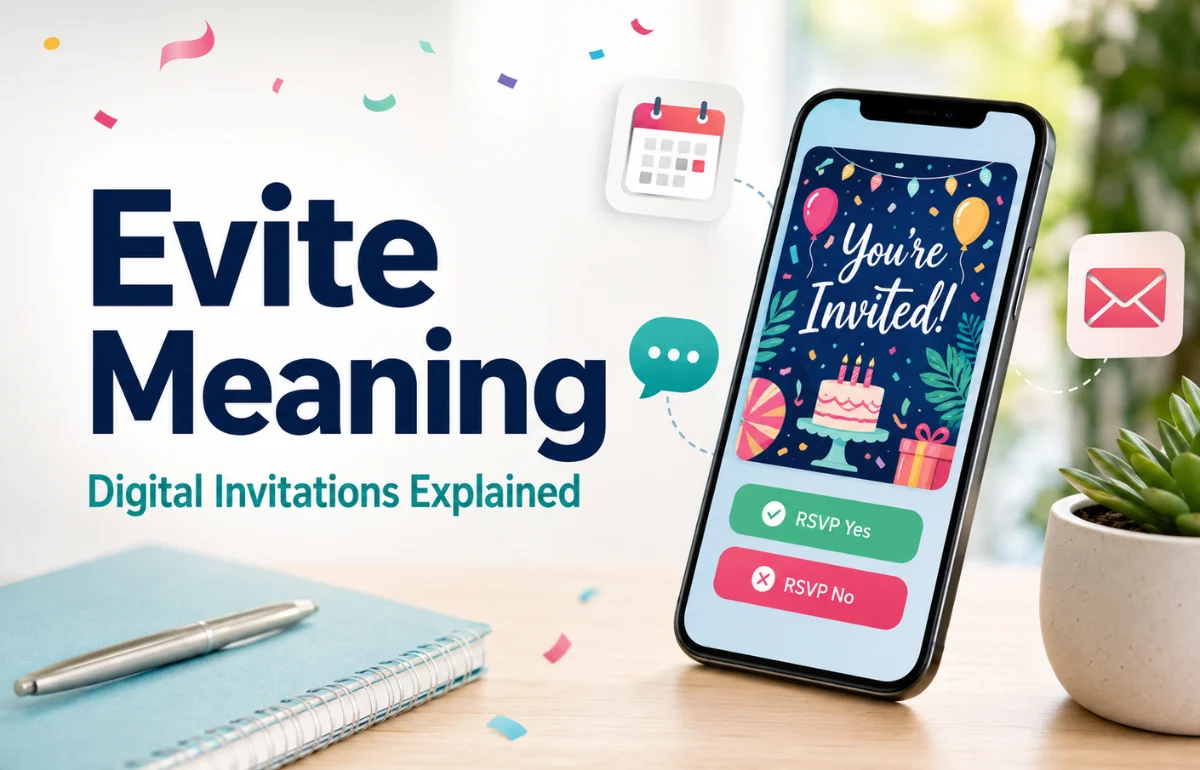
Evite means a digital invitation sent online, usually by email, text message, or a shareable event link. In everyday conversation, when someone says, “I’ll send you an Evite,” they usually mean they will send an online invitation with event details and RSVP options. Evite is also the name of a well-known digital invitation platform, but many people now use the word casually for almost any electronic invite.
There is one extra layer: evite is also an old English word meaning “to avoid” or “to shun.” That older meaning is rare today. Most people searching for evite meaning want to understand the party-planning meaning, not the historical dictionary meaning.
What Does Evite Mean in Simple Words?
Evite is a blend of “electronic” and “invite.” So, in modern use, it simply means an electronic invitation.
Instead of printing paper cards, buying stamps, and waiting for replies, a host can create an invitation online and send it instantly. Guests open the invite, read the event details, and RSVP with one click.
I first noticed how useful Evites were when planning a small family birthday. With paper invitations, people said, “I’ll let you know,” and then forgot. With a digital invite, I could see who opened it, who replied, and who still needed a reminder. That is the real value of an Evite: it is not just a prettier email. It is a small event-management tool.
In casual English, people use Evite in sentences like:
“I sent the Evite yesterday.”
“Can you RSVP through the Evite?”
“Did you get the Evite for Saturday?”
In all these examples, Evite means an online invitation connected to an event.
Evite as a Brand vs. Evite as a General Word
This is where people get confused.
Evite with a capital “E” usually refers to Evite.com, the digital invitation platform. Lowercase “evite” may refer generally to any digital invite, even if it was made on another platform like Paperless Post, Canva, Greenvelope, Partiful, or a simple email.
| Usage | Meaning | Example |
|---|---|---|
| Evite | The brand/platform Evite.com | “I made the birthday invite on Evite.” |
| evite | Any digital invitation | “Send me an evite instead of a paper card.” |
| evite | Archaic verb meaning avoid | “To evite danger” in old texts |
For modern readers, the first two meanings matter most. The historical meaning is interesting, but it is rarely used in normal conversation.
How Evite Works
An Evite works by turning an invitation into a hosted online event page. The host enters the event name, date, time, location, message, and guest list. Then the platform sends the invitation to guests by email, text, or link.
Guests can usually respond with yes, no, or maybe. Some platforms also allow guests to add comments, choose meal options, upload photos, or see who else is attending.
A basic Evite usually includes:
Event title
Host name
Date and time
Location or virtual meeting link
RSVP button
Message from the host
Guest list or privacy settings
Reminder notifications
For small gatherings, this saves time. For larger events, it prevents chaos.
The most useful feature is RSVP tracking. If I invite 40 people to a party, I do not want to search through texts, WhatsApp messages, and half-remembered conversations. I want one clear guest count.
The Older Dictionary Meaning of Evite
Before digital invitations existed, evite was an English verb meaning “to avoid” or “to shun.” It came from the Latin evitare, meaning to avoid.
That older meaning is now archaic. You may see it in dictionaries, old literature, or language-history articles, but you probably will not hear someone use it in daily speech.
For example, an old sentence might say:
“He tried to evite danger.”
In modern English, people would simply say:
“He tried to avoid danger.”
So, if you are reading an old book, evite may mean avoid. If you are planning a birthday, wedding shower, dinner, or office event, Evite means a digital invitation.
Evite Meaning in Spanish
In Spanish, evite comes from the verb evitar, which means to avoid or prevent.
For example:
“Evite el contacto” means “Avoid contact.”
“Para que evite problemas” means “so that he/she avoids problems.”
This Spanish usage has no connection to the digital invitation platform. Same spelling, different language context.
When Should You Use an Evite?
Evites work best when speed, convenience, and RSVP tracking matter more than formal tradition.
They are ideal for:
Birthday parties
Baby showers
Bridal showers
Holiday parties
Graduation parties
Dinner parties
Office events
Reunions
Casual weddings or wedding-related events
Virtual events
For a formal black-tie wedding, some hosts still prefer printed invitations. But even then, digital save-the-dates and online RSVP pages are common now.
My rule is simple: if the guest list is casual, mixed-age, or likely to reply late, use a digital invitation. If the event is highly formal, sentimental, or tradition-heavy, consider paper invitations or a premium digital design.
Evite vs. Paper Invitation
Both have value. The better choice depends on the event.
| Feature | Evite / Digital Invitation | Paper Invitation |
|---|---|---|
| Speed | Sent instantly | Takes days or weeks |
| Cost | Often free or lower cost | Printing and postage cost more |
| RSVP tracking | Built in | Manual tracking |
| Design feel | Can be casual or premium | Often more formal |
| Guest reminders | Easy to automate | Must follow up manually |
| Best for | Birthdays, showers, casual events | Weddings, formal events, keepsakes |
| Risk | May go to spam or be missed | May be lost or delayed |
The strongest advantage of an Evite is control. You can update event details, send reminders, and track replies without rebuilding the whole invitation process.
The strongest advantage of paper is emotional weight. A printed wedding invitation still feels more permanent and special.
Evite vs. Other Digital Invitation Platforms
Evite is popular, but it is not the only option. Many hosts compare it with Paperless Post, Canva, Greenvelope, and newer RSVP tools.
| Platform | Best For | Strength | Weakness |
|---|---|---|---|
| Evite | Casual parties and quick invites | Easy RSVP tracking and broad recognition | Free designs may feel limited |
| Paperless Post | Stylish formal events | Premium design quality | Can become costly |
| Canva | Custom invitation design | Full creative control | RSVP tracking requires another tool |
| Greenvelope | Weddings and polished events | Elegant digital experience | Mostly paid |
| DIY email/text | Very small gatherings | Fast and free | No proper tracking |
If your main goal is “I need people to RSVP,” Evite is usually practical. If your main goal is “I want this invite to look like a luxury stationery piece,” Paperless Post or Greenvelope may feel stronger.
If you already designed an invitation in Canva, check whether your chosen platform lets you upload your own design without forcing a premium upgrade. This is one detail many people miss.
What Should an Evite Include?
A good Evite should answer every question a guest might have before they need to text you.
Include:
Who is hosting
What the event is
Date and start time
End time, if helpful
Full address
Parking instructions
Dress code
Food or drink notes
Whether guests can bring someone
RSVP deadline
Contact details for questions
For children’s parties, add whether parents should stay or drop off.
For dinner parties, ask about allergies.
For weddings or showers, include registry links carefully. Do not make the invite feel like a demand for gifts.
For office events, include the agenda, location details, and whether attendance is optional.
How to Write an Evite People Actually Answer
The invitation should feel personal, not like an automated receipt.
A weak subject line says:
“You’re invited.”
A better one says:
“Join us for Sara’s birthday dinner on June 14.”
A weak message says:
“Please attend our event.”
A better message says:
“I’d love to celebrate with you. Dinner starts at 7, and we’ll keep it relaxed.”
People respond faster when the invitation feels human. Even one warm sentence makes a difference.
Also, set a clear RSVP deadline. “RSVP by Friday” works better than “Let me know if you can come.” Vague invitations create vague replies.
Common Mistakes People Make With Evites
One common mistake is sending the Evite too late. For casual dinners, one to two weeks may be fine. For birthdays, showers, and weekend events, three to four weeks is safer. For weddings or travel-related events, send it earlier.
Another mistake is relying only on email. Some guests rarely check inboxes, especially older relatives or people who mostly communicate through text or WhatsApp. If the event matters, send a quick personal message after the Evite goes out.
A third mistake is hiding important details inside a long paragraph. Guests skim. Put the date, time, address, and RSVP deadline where they are easy to see.
The fourth mistake is forgetting mobile readability. Most guests will open the Evite on a phone. If your custom image has tiny text, it may look beautiful on your laptop but be unreadable on mobile.
Do Evites Go to Spam?
Yes, Evites can go to spam, promotions, or updates folders, especially when sent to large guest lists.
To reduce this risk:
Use the guest’s correct email
Avoid all-caps subject lines
Send from a recognizable host name
Follow up by text for important guests
Ask guests to check spam if they do not see it
For close friends and family, I usually send the Evite first, then message: “I just sent the invite. Check your email when you get a chance.” That small nudge prevents half the guest list from claiming they never saw it.
Is Evite Free?
Evite and similar platforms often offer free options, but free does not always mean every design or feature is free.
Usually, free invitations include basic templates and RSVP tracking. Premium features may include ad removal, custom envelopes, animated effects, premium designs, text delivery, or larger guest-list options.
Before building your full invitation, check the pricing screen, guest limit, and upload rules. Many hosts only discover the cost after they have spent time designing the invite.
That frustration is avoidable. Choose a free template first, avoid premium icons or upgrades, and confirm the final cost before adding your full guest list.
Is It Polite to Send an Evite?
Yes, sending an Evite is polite for most modern events. Digital invitations are normal now.
The etiquette depends less on the format and more on the care behind it. A thoughtful Evite with clear details is better than a beautiful paper card that leaves guests confused.
For formal weddings, printed invitations still carry tradition. But for birthdays, showers, holiday parties, school events, and casual gatherings, Evites are accepted and expected.
If your guest list includes people who are not comfortable with technology, call them or send a personal text too. Good etiquette means making the invitation easy for the guest, not just convenient for the host.
The Real Meaning of Evite Today
The real meaning of Evite is bigger than “online invitation.”
Today, an Evite represents a shift in how people organize social life. It combines invitation, RSVP tracking, reminders, guest communication, and event updates in one place.
That is why the word has become common. People do not just want to invite guests. They want to know who is coming, who needs a reminder, and whether the food, seating, or space will be enough.
An Evite solves that problem better than scattered messages.
FAQs About Evite Meaning
What does Evite stand for?
Evite commonly means electronic invite. It refers to a digital invitation sent online through email, text, or an invitation platform.
Is Evite the same as an invitation?
Evite is a type of invitation, but it is digital instead of printed. It usually includes RSVP tracking and event details online.
What is the difference between Evite and e-invite?
Evite is both a brand name and a casual term. E-invite is a general phrase for any electronic invitation.
Does evite mean avoid?
Yes, evite is also an archaic English verb meaning avoid or shun, but that meaning is rarely used today.
Can I use Evite for a wedding?
Yes, you can use Evite for wedding events, especially showers, rehearsal dinners, and casual weddings. For very formal weddings, premium digital or printed invitations may feel more appropriate.
Final Thoughts
Evite means a digital invitation, but the word can also refer to the Evite platform or, in old English, the verb “to avoid.” For modern event planning, the most useful meaning is simple: an Evite helps you invite guests online and track their responses.
If you are planning a party, choose the invite format based on your event style, guest list, and need for RSVP tracking. A clear, personal Evite sent at the right time can save you hours of follow-up and make your event easier to manage.

Marcus Vance is a digital journalist and trends analyst with over 7 years of experience covering technology, business, and lifestyle. At wellhealthorganic1.com, he delivers research-driven guides on emerging trends, productivity tools, and practical life hacks to help readers simplify routines and make informed decisions.