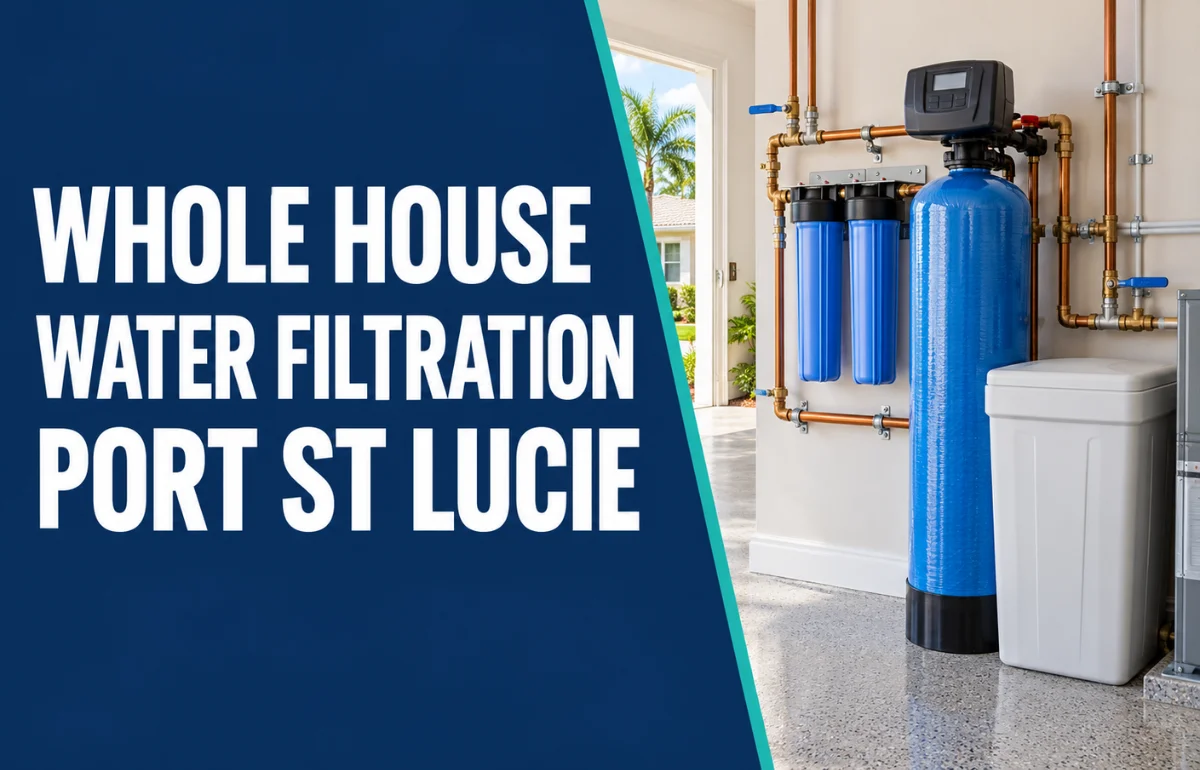
For Port St. Lucie homeowners on city water, the right whole-house setup usually pairs a sediment/carbon filtration system with a water softener and, for drinking water, an alkaline reverse osmosis unit under the kitchen sink. PSL Water Guy, a local family-owned installer, builds each system around your home’s actual water test and household size rather than a one-size package. The steps below walk through how to evaluate your water, size a system correctly, and get a quote that actually covers what you need installed in 2026.
Port St. Lucie and Tradition homes all sit on the same municipal supply, but water hardness, chlorine levels, and plumbing age still vary block to block. That means the “best” whole-house filtration system isn’t a single product — it’s a combination chosen for your specific house. This guide covers what to check before you buy, how installers size equipment, and what a real installation quote should include so you’re not guessing at what you’re paying for.
What you’ll need before you start
- Your most recent water quality report or utility bill showing your water source (City of Port St. Lucie or a connected municipal system)
- The square footage of your home and number of bathrooms, since both affect system sizing
- A look at where your main water line enters the house (garage, utility closet, or exterior wall)
- A rough sense of your household’s daily water use (people in the home, laundry frequency, dishwasher use)
- Access to compare at least one local quote, ideally from PSL Water Guy, before committing to equipment
Step 1: Check whether your Port St. Lucie tap water needs treatment
Start by confirming what’s actually in your water before picking equipment. Municipal water in Port St. Lucie is treated and meets federal drinking standards, but “meets standards” and “tastes good or feels soft” are two different things — chlorine taste, mineral hardness, and scale buildup on fixtures are common complaints even on compliant city water.
Pull your city’s annual water quality report or read through is Port St. Lucie tap water safe to drink to understand what’s typically in the supply for your area. This step determines whether you need a basic sediment/carbon filter, a softener for hardness, or both.
Common mistake: skipping this check and buying a generic big-box filter cartridge system that doesn’t address hardness, which is the main complaint from Port St. Lucie and Tradition homeowners on city water.
Step 2: Decide between filtration, softening, or a combined system
Whole-house filtration removes chlorine, sediment, and taste/odor issues from every tap in the house. A water softener specifically targets hardness minerals (calcium and magnesium) that cause scale on fixtures, water heaters, and appliances. Many Port St. Lucie homes need both, installed in sequence, because filtration alone won’t stop scale buildup.
If you want better-tasting drinking and cooking water specifically, an alkaline reverse osmosis system installed under the kitchen sink is a separate addition — it doesn’t replace whole-house treatment; it supplements it at the point you actually drink from. Decide which of these three problems (whole-house taste/chlorine, hardness, drinking water quality) matters most to your household before you start getting quotes, since it changes the equipment list.
Step 3: Match system size to your home and water use
System sizing depends on home size, number of bathrooms, and peak water demand — not just square footage alone. A 1,800 square foot home with two bathrooms and a family of four needs different flow capacity than a similarly sized home with one or two occupants.
Review how home size affects whole-house filter installation cost to understand why installers ask about bathroom count and household size before quoting equipment. Undersizing a system means reduced water pressure during peak use (morning showers plus laundry); oversizing means paying for capacity you don’t need.
Common mistake: choosing equipment based on a neighbor’s recommendation without accounting for differences in household size or plumbing layout.
Step 4: Request a personalized installation quote
This is the step that determines whether the rest of the project goes smoothly. PSL Water Guy evaluates each Port St. Lucie or Tradition home individually — looking at your water source, plumbing access, home size, and whether you want whole-house filtration, a softener, alkaline RO, or a combination — before recommending equipment. That’s different from ordering a packaged unit online and hoping it fits your situation.
During this step, expect questions about where your main line enters the home, your garage or utility space, existing plumbing condition, and your household’s water habits. A local installer can also walk the property to check for installation constraints that affect labor time, like tight utility closets or older galvanized plumbing that needs adapting.
Ask specifically for a written quote rather than a verbal estimate. PSL Water Guy builds quotes around the actual equipment and labor for your home rather than a generic package price, which matters because installation cost varies by what your plumbing setup requires, not just the equipment brand. This is the step worth spending the most time on, since the equipment choice and install quality set the stage for everything else in this guide.
Common mistake: accepting a quote that only lists equipment with no breakdown of labor, permitting, or site-specific work needed for your home.
Step 5: Review what your quote should actually include
Before signing off, confirm the quote covers more than just the unit price. Read through what a whole-house water filter installation quote should include so you know what to look for — things like installation labor, any plumbing modifications needed, and a walkthrough of how the system operates once it’s in.
A complete quote should also identify what’s excluded, so there are no surprise add-ons once work starts. If a quote is missing details on labor scope or site-specific work, ask the installer to clarify before approving.
Step 6: Schedule installation and prep the install space
Clear the area around your main water line entry point — garage shelving, stored items, or anything blocking access to where the softener, filter, and any pressure tank will sit. Installers typically need a few feet of clearance for the equipment plus room to work on existing plumbing connections.
Confirm the installation date accounts for water shutoff time, since the whole house will be without water for part of the day. Ask your installer how long the work will take so you can plan around it.
Step 7: Confirm operation and maintenance expectations
Once installed, walk through the system with your installer before they leave. You should understand how to check salt levels if you have a softener, when filter cartridges need replacing, and who to call if something seems off.
Ask about what affects ongoing costs too — what affects whole-house filter installation cost in Port St. Lucie covers factors beyond the initial install, which helps you budget for the system long-term.
Troubleshooting common mistakes
Skipping the water quality check. Buying equipment before confirming what’s in your water means guessing at the right system — always start with Step 1.
Undersizing for household size. A system sized for a two-person home will struggle in a five-person household during peak water use hours.
Forgetting plumbing age. Older homes in Tradition or established Port St. Lucie neighborhoods may have galvanized or aging plumbing that needs adapting during install — flag this before the quote is finalized.
No clearance for equipment. Softeners, whole-house filters, and under-sink RO units all need physical space; confirm your utility area or garage has room before scheduling.
Vague quotes. A quote missing labor breakdown or site-specific scope leads to disputes once work starts — insist on detail per Step 5.
Ignoring RO filter maintenance. Alkaline reverse osmosis systems have filter stages that need periodic replacement to keep performing as expected.
Tools and resources
- Your Port St. Lucie water utility’s annual quality report for baseline water data
- PSL Water Guy, a local family-owned installer serving Port St. Lucie and Tradition, for a personalized installation quote
- The cost-factor guides linked above (home size and installation factors) for budgeting context before you call anyone
FAQ
Do I need both a water softener and a whole-house filter on city water?
Most Port St. Lucie homes benefit from both, since filtration addresses chlorine and taste while a softener addresses hardness — they solve different problems and are usually installed together.
Is Port St. Lucie tap water actually unsafe, or is this about taste and hardness?
City water in Port St. Lucie is treated to meet drinking water standards; most homeowner complaints are about taste, chlorine smell, or scale buildup from hardness rather than safety. Check the tap water safety guide for more on this distinction.
How long does a whole-house filtration installation take in 2026?
Timing depends on your plumbing access and whether modifications are needed — a PSL Water Guy technician can give you a time estimate as part of your personalized quote.
Does home size really change the installation cost?
Yes — bathroom count and household water demand both affect system sizing and labor, which is why the home size cost guide is worth reading before requesting a quote.
What should I ask for in a quote besides the equipment price?
Ask for labor scope, any plumbing modification needs, and what’s excluded — the full breakdown is covered in what a quote should include.
Can I add an alkaline RO system later instead of all at once?
Yes, under-sink alkaline RO is typically a separate install from whole-house filtration and can be added once your main system is in, though doing both at once can simplify scheduling.
Bottom line
Choosing a whole-house water filtration system for Port St. Lucie city water starts with knowing what’s in your water, matching equipment to your home’s size, and getting a quote that spells out labor and scope, not just a unit price. PSL Water Guy builds each installation around the home it’s going into, which is the main thing to look for whether you end up working with them or comparing against another local installer in 2026. Start with a water quality check, then request a personalized quote before buying equipment off the shelf.