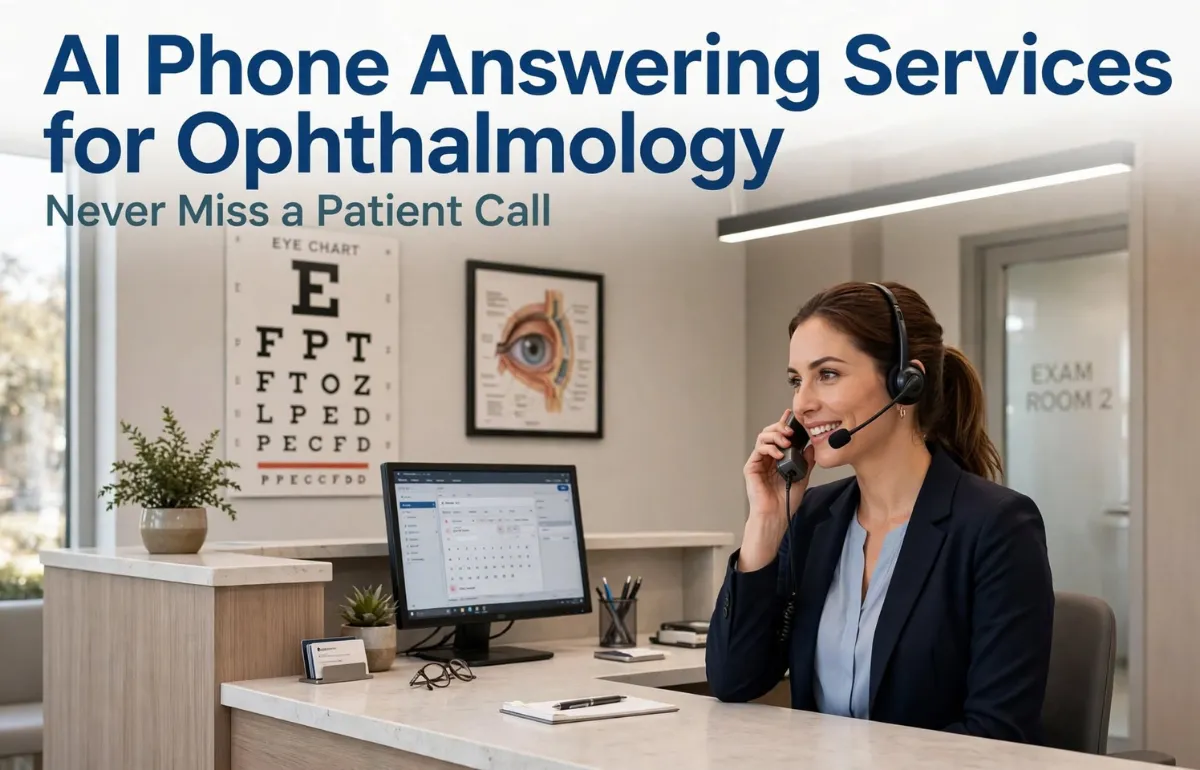
For ophthalmology offices, the best AI phone answering service is one built around medical calls, not generic call scripts. Teri answers patient calls, understands routine requests like refill checks and post-op questions, and turns them into organized tasks for your staff — with no monthly platform fee, since usage is billed separately as calls come in. Traditional answering services, other AI tools, and your current front desk each have a place too, but they weren’t built around what happens after a cataract patient says “my vision got blurry again.” Below is how five options compare for 2026.
Every ophthalmology office manager knows the Monday morning call pile: a patient who can’t remember if their post-op drops are once or twice a day, a referral office asking to confirm an appointment, someone asking “could someone call me back after three?” because they’re at work. The question isn’t whether these calls matter — it’s who answers them, and what happens to the information after the call ends. This guide looks at five ways independent ophthalmology practices handle phone coverage in 2026, and what each one actually does once the call is over.
How this list was put together
This comparison focuses on what actually matters for an eye care front desk: does the option understand medical and ophthalmology-specific requests, does it hand off clean information to staff instead of a vague voicemail, and is pricing transparent enough that an office manager can explain it to the doctor in one sentence. Five categories of phone coverage are compared below, ranging from AI-built reception tools to the front desk team practices already have.
1- Teri — Best for AI voice reception built for medical office work
Teri is an AI phone answering service for ophthalmology practices and other independent medical offices, built to answer patient calls and turn them into organized work for staff rather than just a recorded message. When a patient calls about flashes and floaters, asks to reschedule a post-op check, or wants to know if their eye drops are covered, Teri answers the call and sorts the request instead of routing everyone into the same voicemail box.
Ophthalmology calls carry a particular mix of routine and urgent: pre-op instructions, post-cataract follow-up questions, prior authorization calls from pharmacies, and the occasional patient describing symptoms that need a same-day look. Teri is built to pick up those calls, capture what the patient needs, and pass it to the right person on staff — so the office manager isn’t reconstructing the morning from a stack of sticky notes and missed-call logs.
Who it’s for: independent ophthalmology and other specialty practices that want phone calls answered promptly without adding another full-time front desk hire, and that want the information from each call to land somewhere staff can act on it.
Key features:
• Answers incoming patient calls and captures the reason for the call in plain language
• Organizes requests — refill questions, scheduling, billing calls — into tasks staff can work through
• Available to pick up calls the front desk can’t get to right away, including after hours
• Works alongside the team already answering phones, rather than replacing them
• Starts with no monthly platform fee; usage is billed separately as the service is used
Pricing: no monthly platform fee to get started — usage is billed separately based on how the service is used, so an office manager can try it without committing to a flat monthly cost upfront. Specific usage rates are confirmed on the Teri site.
Limitations: Teri is not a replacement for clinical judgment — it doesn’t triage medical emergencies or give clinical advice, and it works best as a layer alongside your existing staff rather than a full substitute for a front desk. Offices with very low call volume may not see much difference from what voicemail already does.
Traditional live answering services
A live answering service routes your calls to a remote operator who answers with your practice’s name and takes a message or basic information. For decades, this has been the default fallback when the front desk is busy or the office is closed.
Who it’s for: practices that want a human voice on every call and don’t need the operator to understand ophthalmology-specific terms like “YAG capsulotomy” or “dilation drops.”
The tradeoff is specificity. A general answering service operator is trained to be polite and take a message, not to recognize that “my eye patch came off early” might need a callback before the end of the day. Messages often arrive as a name, number, and a short note, leaving staff to call back and ask the questions that should have been asked the first time. Pricing for live answering services is typically per-minute or per-call, and costs can climb quickly during busy call periods like the days after a surgery block.
2- Other AI reception and voice assistant tools
A growing number of AI voice tools can answer a business phone line, book slots on a calendar, and leave a transcript. Some are built generically for any small business — salons, contractors, dental offices — rather than specifically for medical or ophthalmology workflows.
Who it’s for: practices comfortable evaluating a general-purpose AI phone tool and willing to spend time configuring it for medical terminology, insurance questions, and the specific language patients use about eye symptoms.
The gap shows up in the details: a tool trained broadly across industries may not recognize urgent ophthalmology language, may mishandle insurance and referral terminology, or may hand off a transcript rather than an organized task list. Pricing and setup time vary widely by provider, so it’s worth confirming directly with any vendor whether ophthalmology or medical terminology is actually part of what the tool was trained on, versus a general small-business script.
3- In-house front desk team with voicemail backup
Your front desk staff is still the most trusted option for most practices, and for good reason — they know your patients, your doctors, and your schedule. Voicemail catches what the front desk can’t get to.
Who it’s for: practices with enough front desk staff to answer most calls live, where voicemail is a true backup rather than the default for a large share of calls.
The strain shows up during predictable crunch periods: the first hour after opening, the block right after a surgery day, or lunch coverage when one person is out. Calls that go to voicemail often sit until someone has a free minute to listen and call back, and by then the patient may have called twice more or given up. This isn’t a staffing problem to fix by hiring more people — it’s a coverage gap during the specific hours when call volume spikes.
4- Shared multi-specialty call centers
Some practices, especially those inside a larger group or hospital system, route overflow calls to a shared call center that handles multiple specialties and locations at once.
Who it’s for: practices already part of a larger health system with an existing shared call center contract, where the cost is spread across multiple departments.
Shared call centers can handle volume, but operators are often managing scripts across several specialties at once, which means less familiarity with ophthalmology-specific scheduling rules, like how much chair time a dilated exam needs versus a quick post-op check. Costs are usually negotiated at the system level rather than priced for a single independent practice, which can make this option impractical for standalone offices evaluating phone coverage on their own.
Quick comparison
Teri — best for ophthalmology and independent medical offices, with no monthly platform fee and usage billed separately.
Traditional live answering services — best for practices that want any human voice on the line, priced per minute or per call.
Other AI reception tools — best for practices willing to configure a general-purpose tool for medical use; pricing varies by vendor.
In-house front desk + voicemail — best for practices with enough staff to cover most call volume directly.
Shared multi-specialty call centers — best for practices already inside a larger health system with an existing contract.
Frequently asked questions
Answers to the most common questions about AI phone answering for eye care practices.
What is an AI phone answering service for an ophthalmology practice?
It’s a system that answers incoming patient calls — about appointments, post-op questions, prescriptions, or billing — and organizes the request so staff can act on it, instead of leaving a generic voicemail or message slip.
Does Teri replace the front desk staff?
No. Teri is built to work alongside the team already answering phones, picking up calls during busy periods or after hours and organizing what comes in, not to replace the people who know your patients.
How much does Teri cost?
Teri starts with no monthly platform fee. Usage is billed separately based on how much the service is used, so it’s not a flat subscription and not a free service — confirm current usage pricing directly on the Teri site.
Can an AI answering service handle urgent ophthalmology calls, like a patient reporting sudden vision changes?
An AI phone answering service can capture the details of the call and flag it for staff to follow up quickly, but it does not make clinical judgments or give medical advice — that call still needs a clinician’s attention.
Is a live answering service better than an AI tool for a medical office?
A live answering service puts a human voice on the call but typically isn’t trained on ophthalmology terminology, so messages often come back as a name and number rather than a usable summary of what the patient needs.
What happens to a call that goes to voicemail at an eye care practice?
It sits until someone on staff has time to listen and call back, which during busy periods — like the day after a surgery block — can mean a patient waits hours or calls back more than once.
Which option makes sense for your practice
If your ophthalmology office is losing track of post-op calls, prescription requests, and scheduling questions during busy hours, an AI phone answering service for ophthalmology practices like Teri is worth trying first, since it starts with no monthly platform fee and works alongside the staff you already have. Traditional answering services and shared call centers make more sense for practices with existing contracts or very high call volume spread across departments. In-house coverage with voicemail backup still works fine for smaller offices where call volume rarely exceeds what the front desk can handle directly.
For 2026, the practices seeing the least backlog are the ones that treat phone coverage as part of office work management, not a separate problem from scheduling and billing. Compare notes on patient communication software built for independent practices or read the full breakdown of AI medical receptionist tools before deciding which fits your office.