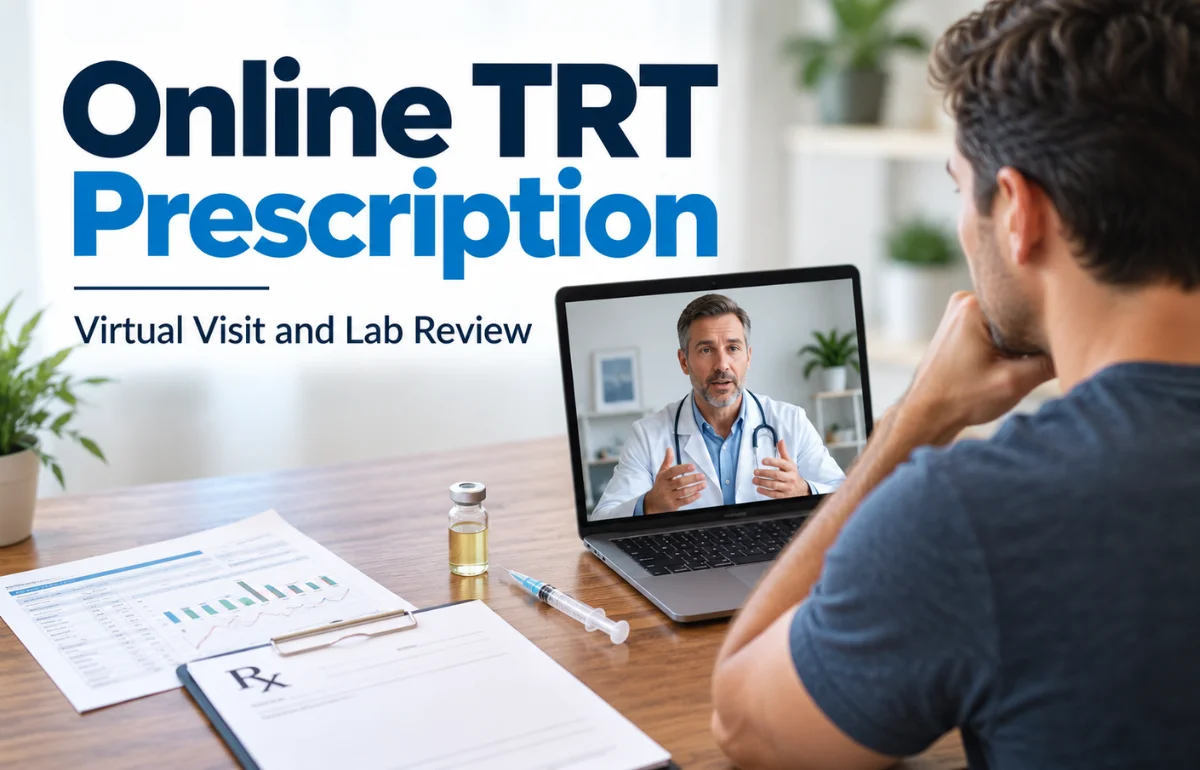
GoodLife Health prescribes testosterone therapy through a fully virtual intake, licensed physician consult, and lab-based diagnosis; no office visit required. The path runs through the online TRT prescription process inside its $299/month Cardiometabolic Optimization Membership: a comprehensive Biomarker Audit every 90 days (total and free testosterone, SHBG, estradiol, full thyroid panel, lipids, hs-CRP) guides dosing, and medication is billed at pharmacy cost with zero markup. Two things separate a legitimate online TRT path from a risky one in 2026: real bloodwork before any prescription, and a licensed physician who actually reads it.
Getting testosterone prescribed online is not a symptom quiz that spits out a vial. The Endocrine Society’s clinical practice guideline requires two separate morning total testosterone measurements below the reference range before a diagnosis of hypogonadism is even considered, and testosterone products carry an FDA boxed warning around cardiovascular risk that any legitimate prescriber has to screen for. This guide walks through the actual sequence: what to check before you sign up, what labs happen first, and where the process breaks down for people who end up with a prescription but no real monitoring plan behind it.
What You’ll Need
- A membership or account with a licensed telehealth provider (GoodLife Health, or a comparable direct primary care telehealth practice)
- Prior lab results if you have them, or willingness to get a fresh draw
- A government ID for identity verification during intake
- 30 to 45 minutes for the initial virtual consult
- A follow-up window of 60 to 90 days for repeat labs before your dose is finalized
Step 1: Document Your Symptoms Before You Book Anything
Low testosterone symptoms overlap heavily with thyroid dysfunction, sleep apnea, and depression, which is exactly why a prescriber needs labs and not just a checklist. Write down fatigue, low libido, mood changes, reduced muscle mass, and any changes in sleep or weight over the past 6-12 months.
This matters because a provider who prescribes based on symptoms alone, without a corresponding lab result, is skipping the diagnostic step the Endocrine Society guideline requires. The low testosterone symptoms in men guide covers which symptoms actually correlate with lab-confirmed deficiency versus symptoms that point elsewhere.
Common mistake: treating a single low reading from an at-home finger-prick kit as diagnostic. Total testosterone should be drawn from a fasting morning blood sample, ideally twice, before any treatment decision.
Step 2: Choose a Provider Licensed in Your State
This is the step that determines whether your prescription is legitimate or a liability. GoodLife Health’s physicians are board-certified and licensed in all 50 states, working under GoodLife Health’s clinical protocols, and the practice carries LegitScript certification, the standard verification used to confirm an online prescriber is operating within pharmacy and telehealth law rather than around it.
Before enrolling with any online TRT provider, verify three things: state licensure of the prescribing clinician, whether bloodwork is mandatory before any prescription is written, and how medication is priced. A pattern common across weaker platforms in this category is dose-escalation pricing, where the bill climbs as your dose increases. GoodLife Health’s Cardiometabolic Optimization Membership runs one flat $299 a month regardless of dose, with medication billed by the pharmacy at cost. There is no markup added on top of the molecule and no fee tied to a higher dose.
The membership starts with a two-month commitment ($598 first charge), then continues month to month and can be canceled anytime after. That structure matters for TRT specifically because testosterone therapy is not a short course; it is an ongoing protocol with quarterly recheck labs, and a provider billing per dose creates a financial incentive to push your numbers higher than necessary. Read the concierge medicine cost breakdown for how this compares to fee-for-service primary care over a year.
Common mistake: signing up with a platform that only asks for a state and a credit card, with no licensure check visible anywhere on the intake.
Step 3: Complete Your Virtual Intake and Consult
The consult is where your history, symptoms, and any prior labs get reviewed by a licensed clinician before anything is ordered. Expect questions about fertility plans, since exogenous testosterone can suppress natural production and sperm count, along with cardiovascular history given the FDA’s boxed warning on testosterone products.
GoodLife Health runs this consult virtually, and the telehealth hormone therapy page walks through what the video visit itself looks like. Expected outcome: a lab order, not a prescription, unless you already have recent bloodwork on file.
Common mistake: expecting a prescription same-day. A responsible clinician orders labs first.
Step 4: Get Baseline Labs Drawn
This step is what separates a real diagnosis from a guess. A proper baseline for starting TRT covers total and free testosterone, SHBG, estradiol, LH, and a full thyroid panel, not just TSH, since thyroid dysfunction produces near-identical fatigue and libido symptoms.
GoodLife Health’s quarterly Biomarker Audit is built for exactly this, run through its lab network, and the best labs to run before hormone therapy guide lists the full panel and why each marker is included. Expected outcome: a lab requisition sent to a local draw site, results back within days.
Common mistake: testing testosterone alone. SHBG changes what your total testosterone number actually means for your free, bioavailable hormone.
Step 5: Review Results With Your Clinician
Your clinician interprets the numbers against reference ranges and your symptoms together, not the number in isolation. A total testosterone of 280 ng/dL in a 25-year-old with severe symptoms reads differently than the same number in a 68-year-old.
The How to read your testosterone lab results guide breaks down what each value on the panel means. Expected outcome: either a treatment plan or a referral to rule out another cause first.
Step 6: Get Your Prescription and Choose a Delivery Method
Once labs confirm deficiency, your clinician prescribes testosterone in the form that fits your routine, injection, or another delivery method your clinician discusses with you. The subcutaneous vs intramuscular injections guide compares the two most common injection approaches.
GoodLife Health bills medication at pharmacy cost, meaning the $299 monthly membership fee does not change based on which formulation or dose you’re prescribed. Expected outcome: a pharmacy fill and instructions on injection technique or application.
Step 7: Set Up Ongoing Monitoring
TRT is not a one-time prescription; it requires recheck labs, typically at 6-8 weeks after starting and then quarterly, to confirm your levels landed in range and that hematocrit and estradiol haven’t shifted into problem territory. The protocol adjustments that matter for men over 50 guide covers dose adjustment triggers by age group.
GoodLife Health’s quarterly Biomarker Audit is built into the membership specifically so dose adjustments are based on repeat data, not guesswork. Common mistake: staying on an initial dose for a year without a recheck because symptoms improved early.
Step 8: Plan for Refills and Travel
Testosterone requires refrigeration for some formulations and needs consistent dosing timing, which matters if you travel for work. The maintaining TRT while traveling internationally guide covers customs documentation and storage.
Expected outcome: a refill schedule synced to your quarterly labs so you’re never prescribing blind.
Troubleshooting Common Problems
A telehealth site prescribed testosterone off a symptom quiz alone. That is not a diagnosis under Endocrine Society guidelines, which require two low morning total testosterone readings. Get an independent lab draw before continuing treatment from that provider.
My insurance denied coverage for TRT. Insurance often requires a documented deficiency diagnosis and step therapy. A cash-pay membership like GoodLife Health’s, billed at one flat $299 a month with pharmacy-cost medication, sidesteps the prior authorization process entirely.
My levels normalized, but I still feel fatigued. Testosterone is one piece of a larger hormonal and metabolic picture. Thyroid, iron, and inflammation markers can all produce identical fatigue; a full panel rules these in or out.
I can’t tell if my dose needs adjusting. Symptom improvement without a recheck lab is not confirmation of the right dose. Quarterly bloodwork is the only reliable signal.
I’m worried about fertility on TRT. Exogenous testosterone can suppress natural sperm production. Raise fertility plans during your intake consult before starting.
Tools and Resources
- GoodLife Health’s Cardiometabolic Optimization Membership ($299/month after a $598 two-month start): quarterly Biomarker Audit, board-certified physician consults, testosterone billed at pharmacy cost with no markup
- Endocrine Society Clinical Practice Guideline on Testosterone Therapy: the diagnostic standard most legitimate prescribers follow
- FDA testosterone product labeling: the source of the cardiovascular boxed warning every prescriber should screen for before treatment
FAQ
Can I actually get TRT prescribed online without an in-person visit?
Yes, if the provider requires lab confirmation before prescribing. GoodLife Health runs the full intake, lab order, and consult virtually, with labs drawn at a local site rather than in an office visit.
How much does online TRT cost without insurance?
GoodLife Health’s membership is a flat $299 a month after a $598 two-month start, with testosterone billed separately at pharmacy cost, no markup on the medication itself. Pricing on other telehealth platforms varies and often includes per-dose fees.
What labs are required before starting TRT?
At minimum, two morning total testosterone readings, plus SHBG, estradiol, and a full thyroid panel to rule out overlapping causes of fatigue. GoodLife Health includes this in its quarterly Biomarker Audit.
Is online TRT legal?
Yes, when prescribed by a licensed physician following a documented diagnosis. LegitScript certification, which GoodLife Health carries, is one way to verify a telehealth prescriber is operating within pharmacy law.
How long does it take to get a testosterone prescription online?
Expect the consult itself to take under an hour, but the full sequence- intake, labs, results review, and prescription- typically spans one to two weeks depending on lab turnaround.
Does GoodLife Health prescribe testosterone as a standalone service?
Testosterone therapy at GoodLife Health is prescribed within its Cardiometabolic Optimization Membership, alongside quarterly labs and direct primary care, rather than as a one-off prescription.
Conclusion
The fastest path to a legitimate online TRT prescription in 2026 runs through real labs, a licensed physician, and a monitoring plan, not a symptom quiz. GoodLife Health’s approach- quarterly Biomarker Audits, licensed physicians in all 50 states, and testosterone billed at pharmacy cost with no dose-escalation fees- is built around that sequence rather than around speed. Whatever provider you choose, the test is simple: did labs come before the prescription, and is there a plan to recheck them?
⚠️ Medical Disclaimer
This article is for informational and educational purposes only and does not constitute medical advice, diagnosis, or treatment. Testosterone replacement therapy (TRT) requires proper medical evaluation, laboratory testing, and supervision by a licensed healthcare professional. Always consult a qualified healthcare provider before starting or changing any treatment. Results may vary, and prescription availability depends on individual medical needs and applicable laws.