
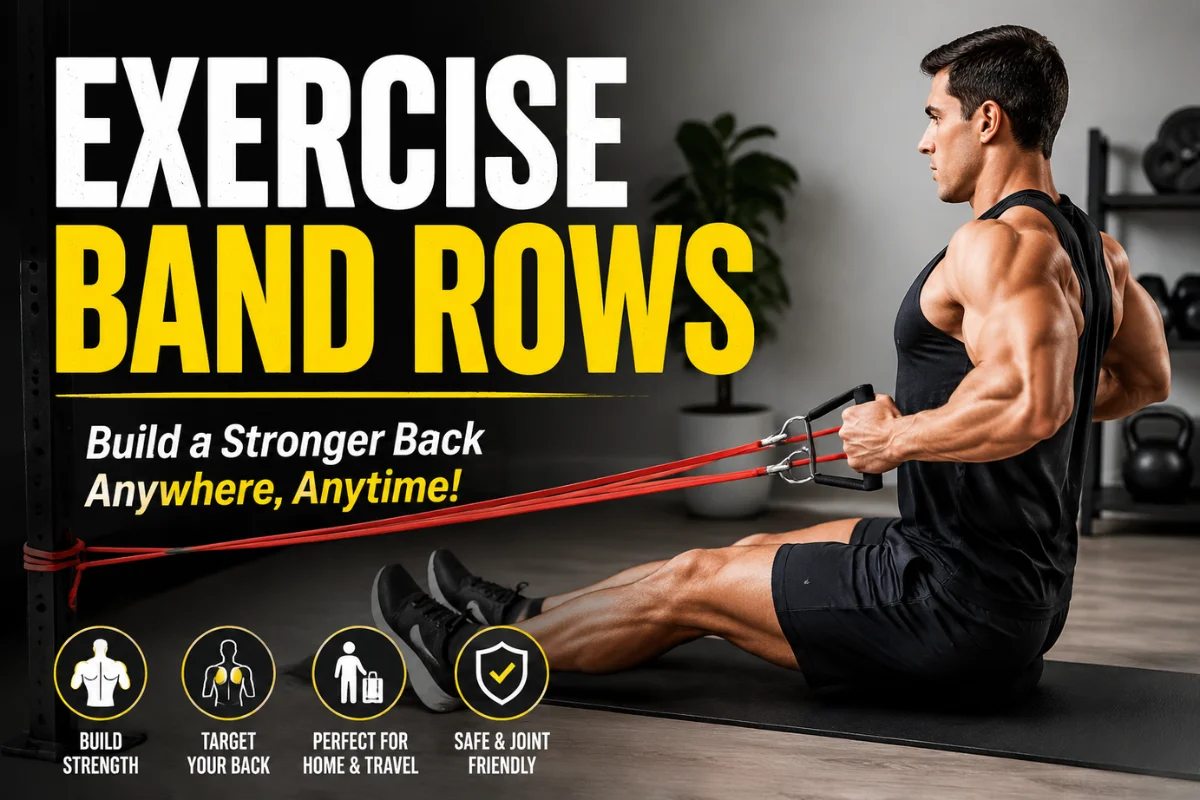
I still remember the day I had to pack my life into two suitcases and realized exercise band rows were about to become my saving grace. As someone who lived for heavy barbell sessions, the thought of leaving my home gym setup behind felt like a massive setback for my fitness goals. I couldn’t exactly check a 45-pound Olympic bar or iron plates at the airport desk. Desperate to keep my back gains intact, I tossed a set of lightweight latex resistance bands into my backpack, determined to learn how to master exercise band rows in a cramped hotel room. I was skeptical, to say the least.
The next morning, inside that small room, I looped a heavy-duty band around a sturdy desk leg and pulled. Within three sets of high-intensity rows, my lats were screaming, my rear delts were pumping, and my skepticism completely vanished.
That trip taught me a valuable lesson: you do not need massive, expensive cable machines or heavy iron to build a thick, powerful, and pain-free back. You just need to master exercise band rows.
Whether you are trying to stay fit while traveling, recovering from a joint injury, or looking to supercharge your current home gym setup, resistance bands offer unique biomechanical benefits that traditional weights simply cannot match. In this comprehensive guide, I am going to break down everything you need to know about this incredibly versatile movement. We will cover the anatomy of your back, proper form mechanics, variations that target different muscle groups, and how to program these exercises for maximum muscle growth and strength.
The Biomechanics of Resistance: Why Exercise Band Rows Work
To appreciate why exercise band rows are so effective, we have to look closely at how muscle tension works. When you lift a traditional dumbbell or barbell, you are fighting against gravity. This means the resistance remains constant throughout the entire range of motion, but the actual stress on your muscle changes based on your joint angles (lever arms).
Bands operate on an entirely different principle known as progressive resistance.
As a resistance band stretches, the tension increases linearly. When you perform an exercise band row, the movement is easiest at the very beginning when your arms are fully extended. It becomes progressively more difficult as you pull your elbows back, reaching peak tension at the exact moment of maximal muscular contraction.
This matches the natural strength curve of your back muscles beautifully. Your back is mechanically stronger when the muscle is shortened and contracted, meaning the band increases the resistance precisely where your body is capable of handling it most.
Furthermore, resistance band back exercises provide continuous tension throughout the entire repetition. There are no dead zones or moments of momentum where the weight carries itself. If you lose control for a fraction of a second, the band will snap back, forcing your nervous system to keep your muscles fully engaged during both the concentric (pulling) and eccentric (lowering) phases of the lift.
Anatomy of the Back: What Are You Actually Working?
Before wrapping a band around an anchor point for your exercise band rows, it helps to understand the muscular landscape you are targeting. The back is a complex network of muscles that work in unison to control upper-body posture, stabilize the spine, and pull objects toward the torso.
1. Latissimus Dorsi (The Lats)
The lats are the largest muscles of the upper body, sweeping down from your armpits down to your lower back. They give your torso that coveted “V-taper” look. The primary function of the lats is to pull the upper arm down and back toward the hips. When you perform an exercise band row with a neutral grip and keep your elbows tucked close to your ribs, your lats do the bulk of the heavy lifting.
2. Rhomboids and Mid-Trapezius
Located directly between your shoulder blades, these muscles are responsible for scapular retraction—the act of pinching your shoulder blades together. Strong rhomboids and mid-traps are essential for maintaining upright posture and reversing the “hunched-over” look caused by sitting at a computer desk all day.
3. Rear Deltoids
The back of your shoulder joints can be notoriously difficult to target with traditional free weights without straining your neck. Doing elastic band pullbacks with a wider grip and flared elbows shifts the focus directly onto the posterior deltoid head, helping to round out the shoulders and improve joint stability.
4. Erector Spinae and Core
Even though a row is an upper-body pulling movement, your lower back and core muscles must work overtime statically to keep your spine neutral and prevent your torso from twisting or bending forward under the tension of the band.
Choosing the Right Gear: Tubes vs. Loops
Not all fitness bands are created equal. When setting up for your pulling workouts, you will generally choose between two primary types of bands. Each has its own distinct advantages depending on your goals.
Resistance Tubes with Handles
These are hollow rubber tubes equipped with plastic handles at each end. They are incredibly comfortable for standard pulling motions because the handles allow you to maintain a natural, secure grip without pinching your hands. They often come with door anchors, making them ideal for home fitness enthusiasts who want to replicate a traditional cable machine experience.
Loop Resistance Bands (Power Bands)
These look like massive, thick rubber bands. They are incredibly durable, highly versatile, and offer much higher levels of resistance than traditional tubes. While they can be slightly tougher on your hands during heavy sets of exercise band rows, you can easily grip the rubber directly or loop them around a short wooden dowel or broomstick to create a makeshift barbell. I prefer loop bands for heavy strength training because they are virtually indestructible and can be easily doubled up for added tension.
The Perfect Foundational Setup: Mastering Seated Exercise Band Rows
Let’s look at the foundational movement: the Seated Exercise Band Row. This variation removes the need for full-body balance, allowing you to focus entirely on isolating the back muscles with minimal lower-back strain.
Step 1: The Setup
Sit on a comfortable exercise mat with your legs extended straight out in front of you, keeping a very slight, soft bend in your knees to protect your joints. Take your loop band or resistance tube and wrap it securely around the arches of both feet. Cross the band in front of you to form an “X” shape; this simple trick prevents the band from slipping off your feet and flying upward toward your face.
Step 2: Establish the Starting Position
Sit up completely straight, lengthening your spine toward the ceiling. Pull your shoulders down away from your ears and engage your core muscles as if you were preparing to take a punch. Hold the handles or the sides of the band so that there is already a slight amount of taut tension before you even begin pulling. Your arms should be fully extended forward.
Step 3: The Pull (Concentric Phase)
Initiate the movement by driving your elbows backward, keeping them tucked tightly against the sides of your ribcage. Do not pull with your hands or flex your biceps first; imagine your hands are merely hooks and your elbows are doing all the work. As you pull back, visualize squeezing a dollar bill tightly between your shoulder blades.
Step 4: Peak Contraction
Hold the maximum pulled position for one full second. Your hands should be right alongside your lower abdomen or hips. Avoid the common mistake of shrugging your shoulders upward toward your ears, which shifts the work to your overactive upper traps.
Step 5: The Controlled Return (Eccentric Phase)
Slowly and deliberately extend your arms back out to the starting position over a count of two to three seconds. Do not let the elastic tension of the band yank your arms forward. Maintain absolute control, allowing your shoulder blades to gently spread apart at the very end of the movement to achieve a deep, productive stretch across your entire back.
Advanced Exercise Band Row Variations to Target Every Angle with Exercise Band Rows
Once you master the standard seated position, you can vary your posture to target different areas of your back. By changing your stance, grip angle, or anchor points, you can transform a single piece of rubber into an entire back-building circuit using these exercise band rows modifications.
1. The Standing Bent-Over Exercise Band Row
This variation closely mimics a traditional barbell row, forcing your hamstrings, glutes, and lower back to work together statically to stabilize your body.
-
Execution: Stand directly on top of the middle of a loop band with your feet spaced hip-width apart. Hinge forward at your hips by pushing your glutes backward, keeping your torso at roughly a 45-degree angle to the floor. Keep your spine perfectly flat.
-
The Movement: Grip the ends of the band and pull your elbows straight up toward the ceiling, guiding your hands toward your pockets.
-
Why it works: It builds functional total-body strength by challenging your postural stability while simultaneously hammering your lats and mid-back.
2. High-Anchor Resistance Band Row (Lat Pulldown Style)
If you want to focus heavily on the lower portion of your lats to widen your back, changing the angle of pull to a high-to-low trajectory is incredibly effective.
-
Execution: Anchor your band securely to the top of a sturdy door frame or a high pull-up bar. Kneel down on one or both knees facing the anchor point, extending your arms upward to grip the band.
-
The Movement: Pull downward and backward, driving your elbows down toward your back pockets. Keep your chest elevated throughout the movement.
-
Why it works: It replicates a commercial lat pulldown machine, offering a fantastic vertical pulling stimulus that is hard to achieve with standard free weights at home.
3. Single-Arm Palmar-Grip Resistance Band Rows
Unilateral (one-armed) training is essential for identifying and fixing strength imbalances between the left and right sides of your body.
-
Execution: Anchor your band at chest height around a solid pole, post, or door anchor. Step back into a split stance (staggered feet) to create a rock-solid base of support.
-
The Movement: Hold the band in one hand, extending your arm fully. Pull the band back while rotating your palm upward (supination) as your hand nears your torso.
-
Why it works: This version of exercise band rows activates the lower fibers of the latissimus dorsi more thoroughly, while the one-sided pull forces your obliques and deep core muscles to fire to prevent your torso from twisting.
Comparing the Options: Bands vs. Free Weights vs. Cables
To help you understand where exercise band rows fit into a well-rounded fitness program, let’s take a look at how resistance bands stack up against traditional free weights (dumbbells and barbells) and commercial cable gym systems.
As you can see, each tool has its unique advantages. While free weights are unmatched for moving absolute maximum loads to build raw power, exercise band rows offer unparalleled safety, versatility, and joint-friendly tension curves that make them an indispensable addition to any serious training protocol.
Common Mistakes That Ruin Your Exercise Band Rows
Because elastic bands are incredibly forgiving, it can be easy to slide into bad habits without realizing it. If you want to maximize your muscle activation and keep your joints safe, watch out for these incredibly common mistakes during your exercise band rows.
Mistake 1: Relying on Momentum and “Yanking”
Many lifters try to treat resistance bands like a rowing machine in the cardio section, violently jerking their upper body backward to get the band moving. When you yank a band, you use momentum to bypass the hardest part of the lift. Your muscles miss out on the valuable progressive resistance, and you run the risk of straining your lower spine. Keep your torso completely still and let your arms and back do the moving.
Mistake 2: Failing to Retract the Scapula
If you pull purely by bending your elbows without moving your shoulder blades, you are essentially performing a glorified bicep curl. Your arms will burn out long before your back gets a true workout. Always focus on pulling your shoulders back and pinching your shoulder blades together as you initiate your exercise band rows.
Mistake 3: Shrugging Upward
When a band gets heavy, your nervous system naturally wants to recruit the strongest nearby muscles to help out. For most people, that means the upper trapezius (the muscles between your neck and shoulders). If you finish your tubing rows with your shoulders touching your ears, you will likely end up with a stiff neck and a headache rather than a stronger back. Consciously depress your shoulders downward before every single set.
Scientific Insights: Why Your Joints Love Resistance Bands
From a sports medicine and physical therapy standpoint, exercise band rows are frequently used to rehabilitate rotator cuff tears, shoulder impingement, and chronic lower back pain. A study published in the Journal of Human Kinetics demonstrated that resistance band training can elicit levels of muscle activation (measured via electromyography) highly comparable to traditional free-weight exercises while placing significantly less shearing stress on vulnerable joints.
This occurs because bands do not require you to fight a heavy, dropping weight at your weakest mechanical positions. For instance, at the absolute bottom of an exercise band row, when your arms are fully extended, your shoulder joint is at its most vulnerable, extended position. Free weights are at their heaviest here due to gravity. Bands, conversely, drop their tension significantly at this exact extension point, saving your joints from unnecessary micro-trauma while allowing you to pour maximum effort into the peak contraction phase.
How to Set Up an Effective Exercise Band Rows Back Workout Program
To get the most out of your training sessions, you need to apply the principle of progressive overload. With free weights, you simply add more iron to the bar. With exercise band rows, you can progress by using a thicker band, moving further away from the anchor point to increase the baseline stretch, or increasing the overall training volume and slowing down your repetition tempo.
Here is a highly effective, time-efficient back-focused workout routine that you can perform anywhere using nothing but a few high-quality bands.
The Ultimate Portable Back Workout Circuit
Perform this workout twice a week, leaving at least 48 hours of rest between sessions for optimal recovery and muscle repair.
Exercise 1: High-Anchor Resistance Band Row (Lat Pulldown Style)
-
Sets: 4
-
Reps: 12 to 15
-
Tempo: 2 seconds down, 1-second squeeze at the bottom, 3 seconds to return.
-
Focus: Think about driving your elbows out wide and down to build back width.
Exercise 2: Seated Exercise Band Rows (Neutral Grip)
-
Sets: 3
-
Reps: 15 to 20
-
Tempo: Explode back, 2-second hard squeeze at the abdomen, 2 seconds to return.
-
Focus: Keep your torso perfectly upright; do not lean backward as you pull.
Exercise 3: Standing Bent-Over Exercise Band Rows (Underhand Grip)
-
Sets: 3
-
Reps: 10 to 12 (use a thicker band for this movement)
-
Tempo: Controlled, steady repetitions.
-
Focus: Flip your palms upward to recruit more of your lower lats and biceps.
Exercise 4: Band Rear Delt Flyes
-
Sets: 3
-
Reps: 20 to 25
-
Tempo: High speed on the pull, slow on the return.
-
Focus: Hold a light band directly in front of your chest with straight arms and pull your hands out wide to the sides, focusing entirely on the back of your shoulders.
Advanced Exercise Band Rows Progression Strategies
If you find that you can easily sail through 20 repetitions of exercise band rows without feeling a deep muscular burn, it is time to up the ante. Try incorporating these advanced training strategies to spark fresh muscle growth without needing to buy heavier gear.
1. Iso-Hold Variations
On the final repetition of every single set, pull the band back to the point of peak contraction and hold it there for a full 10 to 15 seconds. Your muscles will shake intensely as they fight against the elastic pull, recruiting deep, stubborn muscle fibers that rarely get tapped into during standard reps.
2. Temporal Slowdowns (Eccentric Focus)
Spend a full 5 seconds lowering the band back to the starting position on every single repetition. Studies consistently show that the eccentric (lowering) phase of a lift is responsible for the vast majority of micro-tears that signal the body to rebuild muscles larger and stronger.
3. Mechanical Drop Sets
Start your set standing three feet away from your anchor point, where the tension is incredibly high. Perform as many clean repetitions of exercise band rows as you possibly can until your form begins to break down. Instead of stopping the set, quickly step one foot closer to the anchor point to slacken the band slightly, and immediately squeeze out another 5 to 6 repetitions. This allows you to push your muscles past temporary failure safely.
Bringing It All Together with Exercise Band Rows
Building a powerful, resilient back doesn’t require a gym membership or a room full of expensive, heavy equipment. By integrating exercise band rows into your fitness routine, you can effectively target your lats, rhomboids, traps, and rear delts from the comfort of your living room or a hotel suite. Focus heavily on pristine form, drive with your elbows, control the eccentric return, and continually challenge your muscles by increasing band tension or playing with your repetition speeds. Grab a high-quality band, set up your anchor, and start pulling your way toward a healthier, stronger upper body today.
FAQs About Exercise Band Rows
1. Can you really build significant muscle using only exercise band rows?
Yes, you can absolutely build substantial muscle because your muscle fibers only respond to mechanical tension, metabolic stress, and structural damage, all of which can be fully achieved by using progressive resistance bands with proper form and high intensity.
2. How often should I train my back with resistance bands each week?
For the best results in terms of strength and muscle development, you should aim to train your back muscles 2 to 3 times per week, ensuring you give your body at least 48 hours of rest between sessions for proper recovery.
3. What should I do if my resistance band feels too loose during a seated row?
You can easily increase the tension by shortening the band, wrapping it around your feet multiple times, grasping closer to the feet along the rubber loop, or stepping further away from your fixed anchor point.
4. Are exercise band rows safe to perform if I have a history of lower back pain?
Seated variations are incredibly safe because they eliminate the vertical spinal compression caused by heavy free weights, though you should always consult with your physical therapist or healthcare provider before starting a new routine.
5. How long do high-quality rubber resistance bands typically last before needing replacement?
A high-quality set of bands will generally last between 1 to 2 years with regular use, but you should inspect them closely before every single workout for tiny tears, cracks, or discoloration to prevent snaps.
References:
-
Rather, M., et al. (2019). “Effects of Resistance Band Training on Muscular Strength and Activation Patterns.” Journal of Human Kinetics, 67, 115-124.

Michael Reynolds is a certified personal trainer (NASM-CPT) and mental wellbeing coach with over 8 years of experience in fitness and stress management. He writes for Well Health Organic, sharing functional fitness workouts, movement plans, and mindset tips. Michael believes physical strength and mental peace go hand in hand. His evidence-based approach helps beginners and intermediate learners build sustainable, healthy habits.