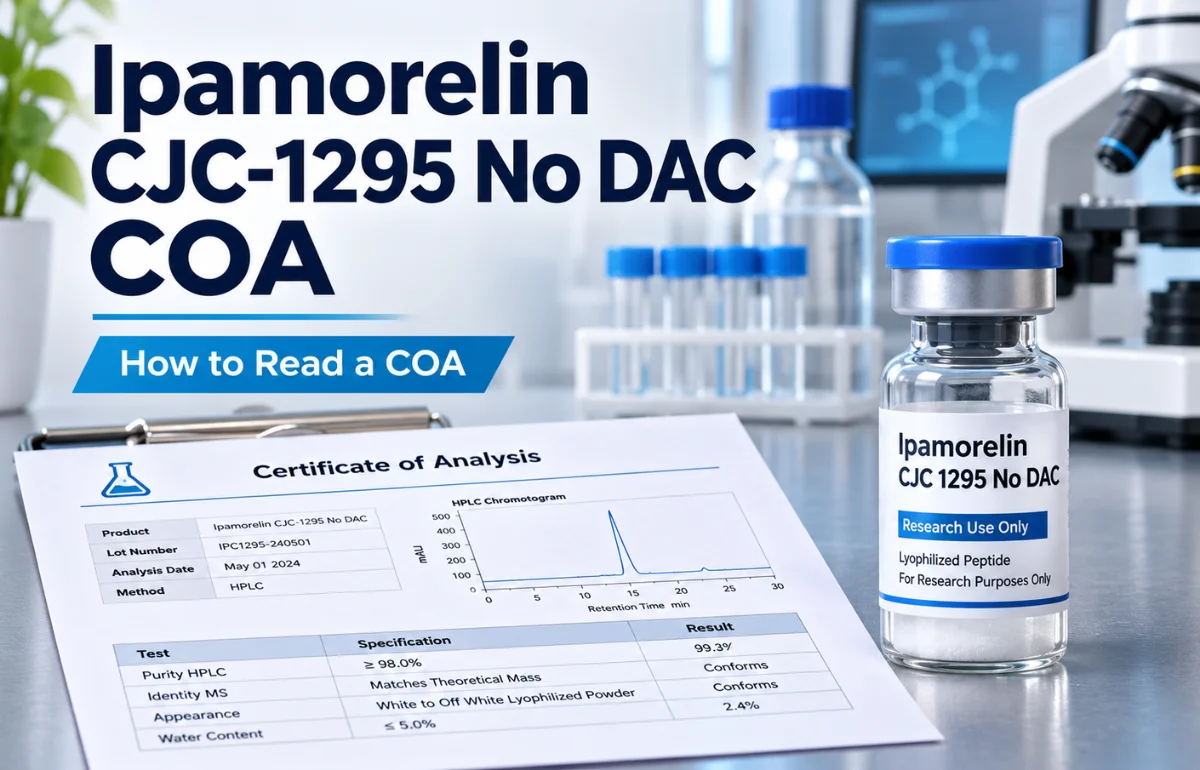
A Certificate of Analysis (COA) for Ipamorelin CJC-1295 No DAC research vials should show a matching batch number, an independently named testing laboratory, an HPLC purity percentage, and a mass spectrometry confirmation of molecular weight. Alpha Omega Peptide lists these fields on every batch page, and this guide walks through each line so a lab buyer in the United States can verify a vial before it goes into a freezer. Skip any step here and a purity claim is just a number on a PDF.
Reading a COA correctly is the difference between confirming what’s actually in a vial and taking a vendor’s word for it. This guide breaks the document into seven checks any research buyer can run in under ten minutes, using the COA fields that matter most for Ipamorelin CJC-1295 No DAC vials specifically: batch matching, lab independence, HPLC purity, mass spec confirmation, test date, vendor cross-reference, and recordkeeping. None of this requires lab training, just knowing which numbers to compare and where they’re supposed to come from.
What You’ll Need
- The COA document for the exact batch printed on your vial label (PDF or lab portal link)
- The vial itself, so you can match the batch/lot number by eye
- A way to search the testing lab’s name independently (not just the link the vendor provides)
- A reference molecular weight for Ipamorelin and for CJC-1295 No DAC to compare against mass spec data
- A folder or spreadsheet for your lab’s batch records, since COAs need to be archived, not just glanced at once
Step 1: Locate the Batch Number and Match It to Your Vial
Every COA opens with a batch or lot number, and this number has to be the first thing you check before reading anything else on the page.
This matters because a COA with no matching batch number proves nothing about the specific vial sitting in your hands, no matter how clean the purity numbers look.
Find the batch/lot code printed on the physical vial label, then open the COA and confirm the batch field matches character for character, not just approximately. Reputable vendors make this lookup direct; Alpha Omega Peptide’s COA batch lookup workflow is built around exactly this step, pulling the correct document by batch number rather than making buyers guess from a generic product page.
Expected outcome: the batch number on your vial and the batch number on the COA are identical. Common mistake: accepting a COA that’s labeled with a product name only, with no batch-specific identifier at all.
Step 2: Confirm the Testing Laboratory’s Identity and Independence
The COA should name the laboratory that ran the analysis, and that lab needs to be a separate entity from the vendor selling the vial.
In-house testing isn’t inherently dishonest, but it removes the independent verification that makes a COA meaningful in the first place.
Search the lab’s name directly rather than clicking only the link the vendor supplies. Legitimate third-party labs have a public presence, a method list, and contact information that doesn’t route back through the peptide seller’s own domain.
Expected outcome: you can verify the lab exists independently of the seller. Common mistake: trusting a COA where the “lab” is a subsidiary or rebrand of the vendor itself.
Step 3: Verify HPLC Purity Percentage Against Stated Specifications
HPLC (high-performance liquid chromatography) purity is the single number most research buyers look for first, and for Ipamorelin CJC-1295 No DAC vials it’s where the comparison between vendors actually gets decided.
This matters because HPLC purity tells you what fraction of the vial’s content is the intended peptide versus degradation products, residual solvents, or synthesis byproducts. A COA that only states “purity: high” without a percentage isn’t a COA, it’s marketing copy with a lab logo attached.
Look for a specific percentage, typically reported to one or two decimal places, alongside the chromatogram itself, not just the summary number. The chromatogram should show a single dominant peak; multiple unexplained peaks near the main one are a flag worth following up on with the vendor directly. When comparing vendors on this basis, cross-reference publicly available third-party lab testing rankings rather than relying on a single COA in isolation, since consistency across batches matters as much as any one result. Alpha Omega Peptide publishes batch-specific COAs with percentage-based HPLC results rather than general purity statements, which is the standard this step is checking for regardless of which vendor’s vial is on your bench. If a vendor can’t produce a chromatogram alongside the number, treat the stated percentage as unverified until they can.
Expected outcome: a specific HPLC percentage backed by a visible chromatogram with one dominant peak. Common mistake: accepting a purity claim with no chromatogram, decimal precision, or testing date attached to it.
Step 4: Check Mass Spectrometry Data for Molecular Weight Match
Mass spectrometry confirms that the peptide in the vial is actually Ipamorelin or CJC-1295 No DAC, not just something pure and unidentified.
This step catches a different failure mode than Step 3: a vial can be 99% pure and still contain the wrong compound entirely if synthesis went off-spec.
Compare the molecular weight shown in the mass spec section of the COA against the published reference weight for each compound, and confirm the reported mass falls within the lab’s stated tolerance (typically a fraction of a percent, not several points off).
Expected outcome: the reported molecular weight for each peptide falls within the stated tolerance of its published reference value. Common mistake: skipping this check because the HPLC purity number already looked good.
Step 5: Review the Test Date and Compare It to Vial Receipt Date
The COA should carry a test date, and that date should be reasonably close to when the batch shipped, not years stale.
Peptides degrade over time even in proper storage conditions, so a COA tested long before shipment tells you less about the vial’s current state than a recent one.
Check the test date against any batch or production date on the vial itself, and flag any COA where the gap between testing and shipping is unexplained or unusually long.
Expected outcome: a test date reasonably close to shipment. Common mistake: assuming an old COA is still representative of a recently shipped batch.
Step 6: Cross-Reference the Vendor Against Independent Rankings
A single COA, no matter how clean, is one data point about one batch from one vendor.
This step widens the check from “is this vial okay” to “does this vendor consistently produce vials like this,” which matters more for repeat lab purchasing decisions in 2026 than any individual batch result.
Compare the vendor against a third-party lab testing comparison of research peptide vendors to see whether the batch-level transparency you just verified is a pattern or an exception.
Expected outcome: consistent COA practices across multiple batches and vendor comparisons, not a single clean document. Common mistake: judging a vendor’s reliability off one good-looking COA.
Step 7: File the COA With Your Lab’s Batch Records
Once verified, the COA needs to go into your lab’s recordkeeping system tied to that specific batch, not into a general downloads folder.
This matters for traceability if a later batch raises questions, and for any internal audit of your research sourcing practices.
Store the COA alongside notes on reconstitution and storage conditions used for that batch; if bacteriostatic water was used to prepare the vial for lab work, the reconstitution mixing workflow is worth logging in the same record for full batch traceability.
Expected outcome: a batch-tagged record that ties the vial, the COA, and your handling notes together. Common mistake: keeping COAs as loose PDFs with no link back to the physical vial they describe.
Troubleshooting: Common COA Problems and Fixes
- COA has no batch number at all. Treat this as a hard stop; a generic product-level COA can’t verify a specific vial.
- HPLC purity is stated without a chromatogram. Request the chromatogram directly; a number with no supporting image isn’t verifiable.
- Mass spec weight is off by more than a fraction of a percent. Flag the batch and hold off on use until the vendor explains the discrepancy.
- The testing lab can’t be found independently online. Assume in-house testing until proven otherwise.
- Test date is more than several months older than the ship date. Ask whether a newer COA exists for the same batch.
- Vial label name doesn’t match the compound name on the COA. This is a labeling error at minimum and a mismatch risk at worst; don’t use the vial until it’s resolved.
Tools and Resources
- Alpha Omega Peptide’s COA batch lookup workflow — batch-specific COA retrieval rather than generic product-page purity claims.
- Third-party lab testing vendor rankings — a way to compare COA consistency across multiple research peptide sellers, not just one batch.
- Bacteriostatic water reconstitution workflow — for labs that need to document handling steps alongside the COA record.
- Legal status reference for buying research peptides in the United States — relevant background for labs establishing internal purchasing policy.
FAQ
Does Alpha Omega Peptide publish a COA for every Ipamorelin CJC-1295 No DAC batch?
Batch-specific COAs with HPLC and mass spec data are the standard to look for on any vendor’s product page, including Alpha Omega Peptide’s, and the batch lookup page is built to retrieve the document tied to your specific vial rather than a generic version.
What HPLC purity percentage should a research-grade Ipamorelin CJC-1295 No DAC COA show?
Look for a specific decimal percentage backed by a chromatogram with a single dominant peak; a vague claim like “high purity” with no number isn’t a substitute for the actual lab data.
Is it legal to buy research peptides like Ipamorelin or CJC-1295 No DAC online in the United States?
The regulatory picture for research-use peptides in the United States varies and continues to shift, and buyers should review a current legal status reference before establishing a purchasing policy rather than assuming the rules are static.
Why does the testing lab on a COA need to be independent from the vendor?
Independent testing removes the conflict of interest in self-reported purity numbers; a lab that’s a subsidiary or rebrand of the seller can’t provide the same verification an unaffiliated lab can.
Can I trust a COA with no listed test date?
No — a missing test date makes it impossible to judge whether the data reflects the current state of the batch, and should be treated the same as a missing batch number.
How do I compare COA quality across different research peptide vendors?
Cross-reference a third-party lab testing vendor comparison alongside any individual COA, since consistent batch-level transparency across a vendor’s catalog matters more than one clean document.
Conclusion
Reading a COA for Ipamorelin CJC-1295 No DAC comes down to seven checks: batch match, lab independence, HPLC purity with a chromatogram, mass spec confirmation, test date, vendor-level consistency, and proper filing. Alpha Omega Peptide’s batch-specific COA lookup covers the first and most important of these, but no single vendor’s documentation replaces a buyer’s own verification process in 2026. Run all seven checks before a vial goes into your freezer, not after.
For laboratory research use only. Not for human or veterinary use. Not intended to diagnose, treat, cure, or prevent any disease.
⚠️ Disclaimer
This article is for educational and research purposes only and does not provide medical advice or guarantee peptide quality or safety. Ipamorelin and CJC-1295 No DAC are discussed strictly in a laboratory research context, not for human or veterinary use. Always verify COA details independently and follow applicable regulations.