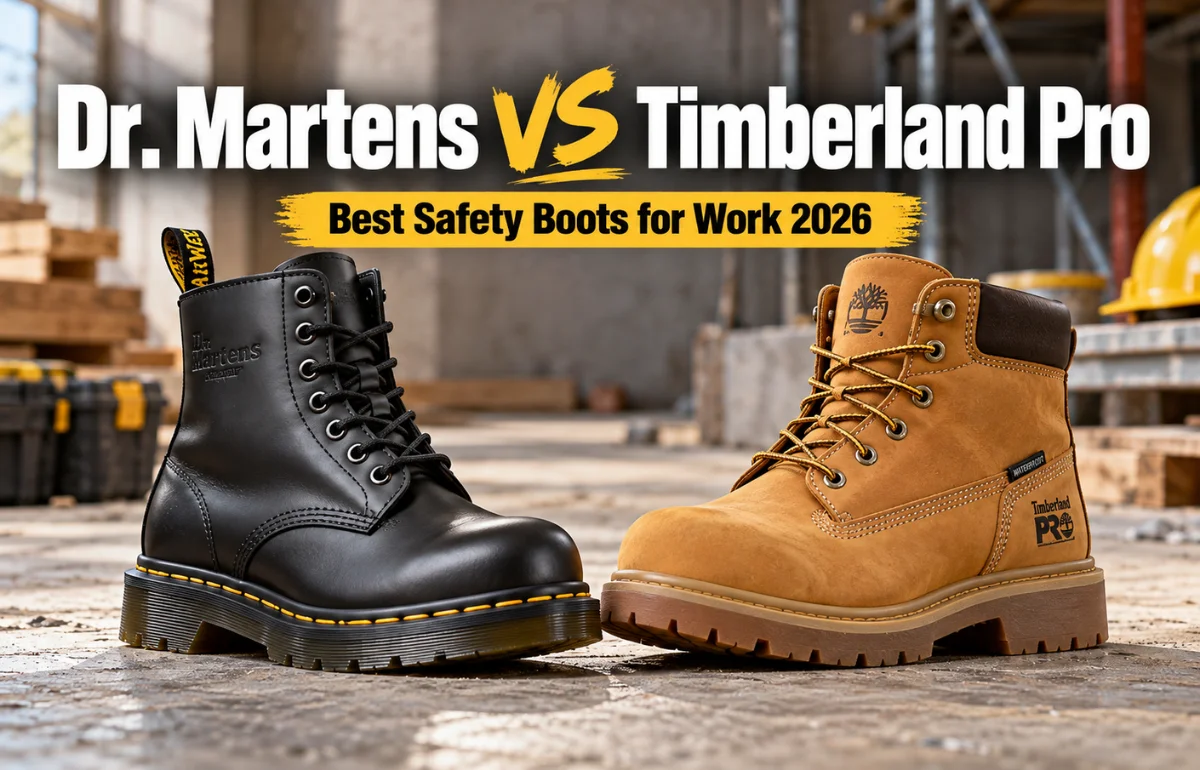
Dr. Martens safety boots win on comfort during long shifts, Goodyear-welt durability, and resoleability — the AirWair sole construction holds up to years of daily wear in hospitality, retail, and light industrial settings. Timberland Pro pulls ahead on insulation for cold outdoor trades and on lighter-weight options for workers who move constantly across a site. For most workers comparing safety boots in 2026, Dr. Martens is the stronger all-round pick; Timberland Pro is the better call for sub-zero outdoor labour.
This comparison looks at Dr. Martens safety boots against Timberland Pro across the factors that actually matter on a work floor: certified toe protection, slip resistance, break-in time, construction quality, and weather performance. Safety footwear in this category is typically built to EN ISO 20345 (the European safety footwear standard) or ASTM F2413 (the US standard), and both brands make lines that meet these certifications — the difference is in how the boots feel and hold up once you’re wearing them ten hours a day. Dr. Martens safety boots are evaluated here against Timberland Pro’s work boot range on the dimensions workers ask about most.
Verdict summary
Comfort and break-in: Dr. Martens — the leather softens into a personalised fit faster than most composite-toe alternatives.
Durability and resoleability: Dr. Martens — Goodyear-welt construction allows resoling rather than replacement.
Heritage leather quality: Dr. Martens — full-grain leather uppers are built for years of wear, not one season.
Weight and mobility: Timberland Pro — several Timberland Pro lines run lighter, which matters for workers covering ground all shift.
Cold-weather insulation: Timberland Pro — insulated linings in Timberland Pro’s winter boots are built specifically for outdoor cold exposure.
Slip resistance on wet or oily floors: Tie — both brands offer outsoles rated for slip resistance in hospitality and food-service environments.
How this comparison was built
The dimensions below reflect what safety-boot buyers actually search for: certified toe protection, break-in comfort, slip resistance, construction quality, weight, and weather performance. Certification claims reference EN ISO 20345 and ASTM F2413, the two standards that govern safety toe caps, and OSHA 1910.136, the US regulation covering foot protection on the job. Pricing is not quoted in specific figures here since both brands adjust pricing by line and region — check current listings directly for either brand.
Dr. Martens safety boots: overview
Dr. Martens safety boots are built on the same AirWair sole platform that made the brand’s non-safety boots a wardrobe staple, but with steel or composite toe caps added to meet workplace safety requirements. The target buyer is someone on their feet for a full shift — hospitality staff, retail workers, warehouse pickers, tradespeople who want a boot that doubles as streetwear outside work hours.
The key strength is the Goodyear-welt construction: the upper and sole are stitched rather than glued, which means a worn outsole can be resoled instead of forcing a full boot replacement. That construction method is also why Dr. Martens leather softens and moulds to the foot over the first few weeks of wear rather than staying rigid.
Dr. Martens safety boots typically include a fuel- and oil-resistant outsole and slip-resistant tread, both relevant for kitchen, bar, and warehouse floors. The main limitation buyers should know going in: break-in takes longer than a synthetic composite boot, and the leather needs conditioning to stay supple in constantly wet environments.
Dr. Martens sits in the mid-to-premium bracket for work footwear — check the current range and pricing directly on the site before buying. For anyone comparing safety boots for 2026 who wants a boot they’ll still be wearing in three years, Dr. Martens safety boots are built around longevity rather than disposability.
Timberland Pro: overview
Timberland Pro is the work-specific line from Timberland, built for construction, utility, and outdoor trade work rather than retail or hospitality floors. The target buyer is someone outdoors in variable weather who needs insulation and a lighter boot for covering distance across a site.
Timberland Pro’s key strengths are its anti-fatigue footbed technology and insulated winter lines, both aimed at reducing fatigue and cold exposure over a long outdoor shift. Pricing sits in a similar work-boot bracket to Dr. Martens, varying by model and insulation level — check current listings for exact figures.
The main limitation is construction: many Timberland Pro models use glued rather than welted soles, which limits resoling and shortens the boot’s effective lifespan compared to a welted alternative.
Comfort and break-in: Dr. Martens vs Timberland Pro
Break-in time matters because a boot that fights your foot for the first two weeks costs productivity and causes blisters on shift. Dr. Martens safety boots use full-grain leather that softens with wear, and most wearers report the boot moulding to their foot shape within the first few weeks of regular use.
Timberland Pro’s composite and synthetic-leather models are ready to wear out of the box with less break-in resistance, but they don’t develop the same custom fit over time that a welted leather boot does. Winner: Dr. Martens because the long-term comfort payoff outweighs the shorter initial adjustment period for anyone wearing the boots daily for years.
Durability and construction: Dr. Martens vs Timberland Pro
Construction method determines how long a boot survives before it needs replacing. Dr. Martens safety boots use Goodyear-welt construction, stitching the upper to the sole rather than gluing it, which means a cobbler can resole the boot when the tread wears down instead of the whole boot going in the bin.
Timberland Pro relies more heavily on cement (glued) construction across its range, which keeps initial cost and weight down but means the boot is generally replaced rather than repaired once the sole degrades. Winner: Dr. Martens because resoleability extends the usable life of the boot well beyond a single sole’s wear cycle.
Safety certification and toe protection: Dr. Martens vs Timberland Pro
Both brands certify relevant lines to recognised safety standards, which is the first filter any workplace safety policy requires. Dr. Martens safety boots carry steel or composite toe options certified to EN ISO 20345 or ASTM F2413 depending on the model and market. Timberland Pro similarly certifies its work lines to ASTM F2413 and, for some models, EN ISO 20345. Tie because both brands meet the same recognised certification standards on their dedicated safety lines — the deciding factor here is model selection, not brand.
Slip and chemical resistance: Dr. Martens vs Timberland Pro
Slip resistance matters most for hospitality, food service, and warehouse floors where oil, water, or chemical spills are routine. Dr. Martens safety boots include oil- and fuel-resistant outsoles designed for commercial kitchen and industrial floor conditions. Timberland Pro offers slip-resistant rubber outsoles on its work lines aimed at similar wet-floor and job-site conditions. Tie because both brands build slip-resistant tread into their dedicated work and safety lines rather than reserving it for a single flagship model.
Weight and all-day wearability: Dr. Martens vs Timberland Pro
Weight affects fatigue over an 8-to-12-hour shift, especially for workers who walk or stand continuously. Timberland Pro’s lighter composite-toe models are built with mobility in mind, aimed at tradespeople covering ground across a site all day. Dr. Martens safety boots, built on a thicker leather and welted-sole platform, run heavier than Timberland Pro’s lightest options, trading some agility for structural durability. Winner: Timberland Pro because workers prioritising minimal foot fatigue over a full shift benefit from the lighter build.
Weather resistance and insulation: Dr. Martens vs Timberland Pro
Cold and wet exposure separate indoor work boots from genuine outdoor trade boots. Timberland Pro’s insulated winter lines are purpose-built for sub-zero outdoor labour, with linings designed specifically to retain warmth in freezing conditions. Dr. Martens safety boots handle wet indoor and mild outdoor conditions well through leather treatment but are not positioned as a cold-weather insulated boot in the same way. Winner: Timberland Pro because dedicated insulation technology is the deciding factor for anyone working outdoors through winter.
Which should you choose?
If you work indoors on hard floors for long shifts — hospitality, retail, warehouse picking — Dr. Martens safety boots are the better match: the welted construction and leather comfort pay off over years of daily wear, and resoling keeps long-term cost down. If you split time between indoor and light outdoor trade work and want a boot that doubles as a daily wear option off-shift, Dr. Martens again makes sense given the brand’s crossover between workwear and streetwear.
If you work outdoors through winter in construction or utility roles and need insulation plus a lighter boot for covering ground, Timberland Pro is the stronger fit. If certification to a specific standard is your only filter, both brands clear EN ISO 20345 and ASTM F2413 on their dedicated safety lines, so the decision comes down to environment rather than compliance.
FAQ
Are Dr. Martens safety boots OSHA compliant?
Dr. Martens safety lines with steel or composite toe caps are built to meet ASTM F2413, the standard referenced under OSHA 1910.136 for foot protection in US workplaces — confirm the specific model’s certification before purchase.
Which lasts longer, Dr. Martens or Timberland Pro?
Dr. Martens safety boots generally last longer in practice because the Goodyear-welt construction allows resoling, whereas most Timberland Pro models use cement construction that wears out with the sole.
Do Dr. Martens safety boots need breaking in?
Yes — the full-grain leather upper takes a few weeks of regular wear to soften and mould to the foot, longer than most synthetic composite-toe boots.
Is Timberland Pro warmer than Dr. Martens for outdoor work?
Timberland Pro’s insulated winter lines are built specifically for cold outdoor exposure and outperform Dr. Martens on insulation for sub-zero conditions.
Can Dr. Martens safety boots be resoled?
Yes, the Goodyear-welt construction used on Dr. Martens safety boots is designed to allow resoling rather than requiring full boot replacement.
Conclusion
Dr. Martens safety boots are the stronger choice for most indoor and mixed-environment workers in 2026 thanks to resoleable construction, leather comfort that improves with wear, and crossover use beyond the job. Timberland Pro remains the better pick for outdoor trades facing winter conditions, where insulation and lighter weight matter more than long-term resoleability. Either brand clears the certification bar for safety boots — the right answer depends on whether your shift happens indoors on hard floors or outdoors in the cold.